
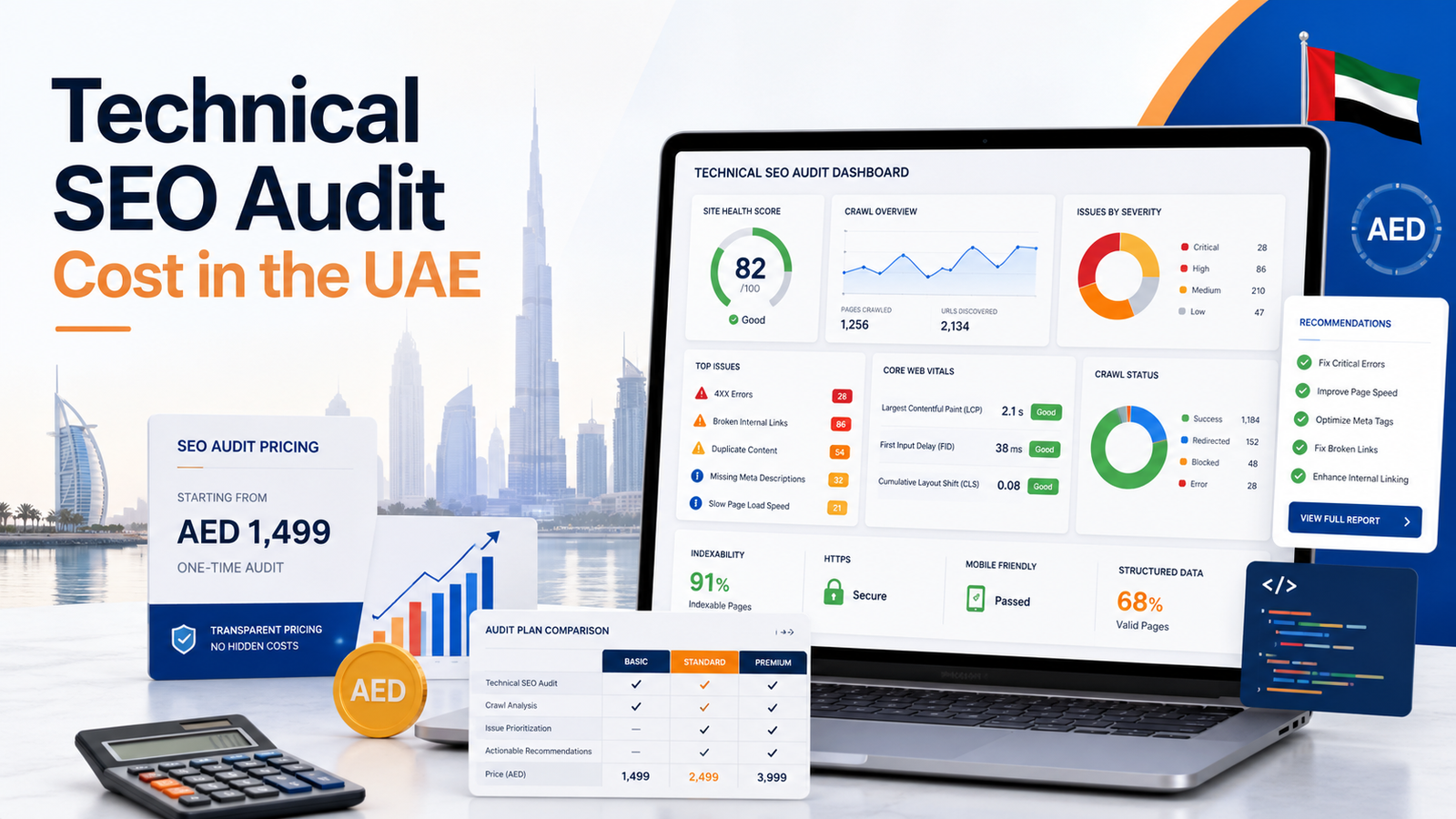
A technical SEO audit in the UAE can cost from approximately AED 950 for a basic automated review to AED 25,000 or more for a comprehensive diagnostic audit. Complex enterprise, ecommerce, JavaScript and multilingual websites generally require custom pricing because the work depends on URL scale, template architecture, rendering systems, data access, root-cause analysis and post-fix validation.
These figures are planning references, not regulated UAE market rates. Publicly listed offers vary significantly: some providers advertise entry-level audits from AED 950–1,500, while published technical and comprehensive audit prices range from approximately AED 3,000 to AED 25,000.
Technical SEO Audit Prices in the UAE at a Glance
| Audit type | Indicative UAE price | Suitible for | Primary Output |
| Automated webiste scan | AED 0-1500 | Small websites requiring an initial health check | Tool-generated error summary |
| focus technical audit | AED 3000-8000 | Small and medium websites with defined technical concerns | Diagnosed findings and prioritised recommendations |
| comprehensive technical audit | AED 5000-25000 | Ecommerce, multilingual, migration or technically complex websites | Root-cause analysis and implementation roadmap |
| enterprise technical review | custom quotation | Large platforms, marketplaces, international websites and multiple CMS environments | System-level diagnosis, developer specifications and validation plan |
Why Do Technical SEO Audit Prices Vary by Depth?
Technical SEO audits generally operate across four levels.
Level 1: Automated Technical Scan
An automated scan identifies common technical conditions such as broken links, redirects, missing metadata, heading problems, non-indexable pages, sitemap inconsistencies and basic structured-data errors.
This service may be useful as an initial screening tool, but it usually provides limited root-cause analysis.
Its central output is:
Detected technical conditions
It should not be represented as a complete implementation-ready audit.
Level 2: Diagnostic Technical Audit
A diagnostic audit combines crawl information with additional evidence such as Search Console, rendered HTML, sitemaps, internal-link data, analytics and historical performance.
The question changes from:
Why does this condition exist, and what does it affect?
Its central output is:
Root causes, affected systems and priorities
Level 3: Implementation-Ready Technical Audit
An implementation-ready audit translates major findings into technical requirements that a development team can interpret.
Each high-priority finding defines:
- Affected URL pattern
- Supporting evidence
- Root cause
- Current technical behaviour
- Intended technical behaviour
- Implementation dependency
- Acceptance criteria
- Validation process
Its central output is:
Developer-ready remediation specifications
This level reduces interpretation gaps between the SEO specialist and the engineering team.
Level 4: Enterprise Technical SEO Review
An enterprise audit evaluates connected systems across large or complex architectures.
The scope may include:
- Large-scale crawl segmentation
- Server-log analysis
- JavaScript rendering
- Multiple CMS platforms
- International architecture
- Faceted navigation
- Website migrations
- CDN behaviour
- Template inheritance
- Subdomains
- Cross-team dependencies
Its central output is:
System-level diagnosis and implementation governance
The cost reflects the number of interacting systems and the risk created by changing technical behaviour at scale.
How Does Website Type Change Technical Audit Scope?
Website type determines the technical entities, relationships and commercial risks that require investigation.
Lead-Generation Websites
A lead-generation audit prioritises the pages that produce enquiries, such as service, industry, location, case-study and contact pages.
The primary risks may include orphan commercial pages, duplicate location templates, archive indexation, weak internal linking and inconsistent canonical tags. in ecommerce seo the optimization is must important.
A 200-page service website may generate most of its enquiries through 20 pages. The audit should therefore prioritise the systems affecting those pages rather than assigning equal commercial importance to every URL.
Ecommerce Stores
An ecommerce SEO audit examines the technical relationship between:
Category → subcategory → product → variant → filter → parameter
The principal risks include uncontrolled filters, duplicate variants, weak category structures, discontinued-product handling, incorrect canonicals, orphan products and template-level structured-data errors.
Diagnostic workload increases with catalogue size, variation rules, faceted-navigation logic and the number of systems that generate URLs.
SaaS Websites
A SaaS website may contain several connected environments:
Marketing website + application + documentation + knowledge base + integration pages + programmatic pages
The audit separates public search assets from application routes. It then examines rendering, subdomain architecture, canonical rules, authentication boundaries, documentation discovery and internal links between commercial and educational content. they required a SAAS SEO for highly working and best result
The complexity comes from environment boundaries, not simply from the number of marketing pages.
Marketplaces and Directories
Marketplaces and directories commonly generate pages through combinations such as:
Service × city × district
The audit evaluates page-generation thresholds, inventory availability, URL rules, crawl depth, pagination, sitemap participation and index coverage.
The main question is not whether a page can be generated. It is whether the page contains enough unique inventory, evidence and user value to justify crawling and indexation.
Arabic Websites
An Arabic SEO audit tests each language independently and then validates the connection between equivalent pages.
The analysis includes hreflang, canonicals, reciprocal annotations, translated URLs, language-level internal links, sitemap coverage, indexation balance and RTL rendering.
A technically functional Arabic page can still perform poorly when navigation, templates or primary content depend on untranslated English elements.
Enterprise Websites
Enterprise audits begin with URL and system classification.
Large organisations may operate multiple subdomains, country folders, CMS platforms, product databases, business units and language versions. The audit therefore evaluates systems and ownership boundaries rather than examining every URL manually.
The diagnostic question becomes the enterprise SEO must important for every website that work proper and give high quality result
Which technical rule creates the condition, how far does it propagate, and which team controls the correction?
What Is the Difference Between Audit Cost and Implementation Cost?
Audit, development, quality assurance and monitoring are separate investment components.
The complete model is:
Total technical SEO investment = audit + development + SEO QA + post-fix monitoring
Audit
The audit covers evidence collection, diagnosis, root-cause analysis, prioritisation, technical recommendations and acceptance criteria.
Development
Development covers changes to code, templates, routing, rendering, CMS rules, databases, CDN configuration, server behaviour and other technical systems.
An SEO consultant may define the required technical state without writing or deploying the production code.
SEO Quality Assurance
SEO QA verifies that the deployed implementation matches the approved requirement.
Testing may include:
- Recrawling affected URL groups
- Checking status codes
- Comparing raw and rendered HTML
- Validating canonical destinations
- Testing hreflang clusters
- Reviewing sitemap changes
- Checking internal links
- Validating structured data
A completed development ticket does not prove that the intended search-engine behaviour has been achieved.
Monitoring
Monitoring evaluates how crawlers and search systems respond after implementation.
Relevant evidence may include indexation patterns, server logs, crawl activity, template visibility, landing-page performance and Core Web Vitals trends.
What Makes a Technical SEO Audit Implementation-Ready?
An implementation-ready audit follows a consistent specification model:
Problem → evidence → root cause → scope → impact → intended behaviour → dependency → validation
Problem and Evidence
The report defines the technical condition and proves it through crawl data, Search Console, server logs, rendering tests, response testing, sitemap analysis or historical URL data.
Root Cause
The report identifies the system creating the problem.
Duplicate URLs, for example, may originate from filters, tracking parameters, CMS archives, product variants, session IDs or sorting parameters. Each cause requires a different technical response.
Affected Scope
The finding identifies the affected URL patterns, page templates, estimated URL volume, language folders, subdomains and commercial page groups.
This converts a single example into a system-level technical requirement.
SEO and Business Impact
Technical severity is evaluated in relation to commercial exposure.
A canonical defect affecting a revenue-generating product template receives a higher priority than the same defect affecting an unused archive.
Intended Technical Behaviour
The recommendation defines the required outcome.
A weak instruction states:
“Fix the canonical tags.”
An implementation-ready instruction defines:
- The affected URL class
- Current canonical behaviour
- Required canonical destination
- Parameter handling
- Internal-link treatment
- Sitemap treatment
- Acceptance criteria
Dependencies
The report identifies dependencies involving CMS restrictions, frontend frameworks, routing logic, databases, product approvals, translation systems and release schedules.
Validation
Every major recommendation includes a testable acceptance criterion.
A finding is closed only when the required technical SEO has been confirmed.
7 Factors That Affect Technical SEO Audit Cost in the UAE
The cost of a technical SEO audit in the UAE depends on the amount of investigation, diagnosis and validation required. Two websites with a similar number of pages may receive different quotations because their platforms, URL structures, rendering systems and commercial risks are different. The following seven factors usually have the greatest influence on the final audit price.
1. Website Size and URL Volume
Website size affects the time required to crawl, classify and analyse pages. A small service website with 50 to 100 URLs may require a focused review, while an ecommerce store, marketplace or directory may contain thousands of products, categories, filters, parameters and automatically generated pages. The auditor must determine which URLs are commercially valuable, duplicated, redirected, blocked, orphaned or unnecessarily indexed. The cost increases when technical problems affect large URL groups because the auditor must identify the underlying template, rule or system rather than report isolated examples.
2. Website Type and Platform Architecture
The type of website determines which technical systems must be investigated. A local lead-generation website may mainly require analysis of service pages, location pages, internal links, indexation and enquiry paths. An ecommerce store also requires investigation of categories, products, variants, filters, pagination and discontinued-product handling. SaaS platforms, marketplaces and enterprise websites may contain subdomains, applications, documentation portals, databases, programmatic pages and multiple content management systems. More connected environments create additional technical dependencies, which increases the diagnostic workload and audit cost.
3. JavaScript Rendering and Frontend Technology
Websites built with JavaScript frameworks such as React, Angular, Vue or Next.js often require additional rendering tests. The content displayed in a browser may differ from the HTML initially delivered to search engines. The auditor may need to compare raw HTML, rendered HTML, browser-visible content, internal links, canonical tags and structured data before and after rendering. Hydration problems, lazy-loaded content, blocked resources and client-side navigation can also affect crawling and indexation. These checks require specialist tools and deeper technical analysis, which can increase the audit price.
4. Ecommerce Filters, Parameters and Duplicate URLs
Ecommerce websites frequently generate multiple URLs for similar or identical content. Product filters, sorting options, tracking parameters, session IDs, product variants and faceted navigation can create thousands of crawlable URL combinations. The auditor must determine which URLs should be indexed, canonicalised, blocked, consolidated or excluded from internal links and XML sitemaps. Audit costs rise when the website has a large catalogue, complex variation rules, multiple filter combinations or inconsistent canonical behaviour because one template-level problem can affect the entire product inventory.
5. Multilingual and International SEO Requirements
Many UAE businesses operate websites in English, Arabic and additional languages. A multilingual technical SEO audit must evaluate each language version separately before confirming how equivalent pages connect. The analysis may include hreflang tags, reciprocal annotations, language-specific canonical tags, translated URLs, country folders, subdomains, internal links, XML sitemaps and right-to-left rendering. The cost increases when several language or country versions are involved because technical errors can affect indexation, regional targeting and the relationship between translated pages.
6. Data Access and Diagnostic Evidence
The availability of reliable data affects the accuracy and efficiency of the audit. A crawler can identify technical conditions, but it cannot always explain their causes or commercial impact. A complete diagnosis may require access to Google Search Console, Google Analytics, the content management system, server logs, CDN settings, historical crawl records, staging environments and previous migration data. Limited access may force the auditor to perform additional tests or work with incomplete evidence. Server-log analysis, historical URL investigation and rendering comparisons can also increase the workload because they require specialist analysis.
7. Audit Depth, Developer Specifications and Validation
The required audit output is one of the largest pricing factors. A basic automated scan may only provide a list of detected errors. A diagnostic audit explains the root cause, affected URL groups, SEO impact and recommended priority. An implementation-ready audit goes further by defining the current technical behaviour, required outcome, implementation dependencies, acceptance criteria and validation process. When the service also includes developer specifications, SEO quality assurance, recrawling and post-fix monitoring, the price is higher because the work extends beyond identifying problems and includes verifying that the intended technical state has been correctly implemented.
How Are Technical SEO Findings Prioritised?
Error count is not an effective prioritisation method.
A more useful model is:
Priority score = business impact × SEO impact × affected scale × urgency ÷ implementation effort
Ten thousand warnings on a low-value archive may have less commercial importance than one noindex rule affecting the website’s primary service pages.
Critical Findings
Critical findings can directly prevent important pages from being crawled, rendered, indexed or preserved during migration.
Examples include accidental noindex directives, robots.txt blocking, incorrect canonicals, broken migration redirects, rendering failures and error responses on commercial templates.
High-Priority Template Problems
These conditions propagate across important page groups.
Examples include canonical generation defects, missing internal links, invalid hreflang clusters, malformed structured data and rendering problems inherited from a template.
Architecture and Internal-Linking Problems
These findings affect discovery, crawl depth and authority flow.
The audit may evaluate orphan pages, navigation, breadcrumbs, contextual links, category hierarchy and paths to commercially important URLs.
Crawl-Efficiency Problems
These findings cause repeated crawling of duplicate, redirected, parameterised or low-value URLs while important page groups receive weaker discovery.
Technical Hygiene
Lower-priority findings include isolated broken links, unnecessary redirect hops, minor sitemap discrepancies and non-critical structured-data errors.
These issues remain in the roadmap without displacing critical indexation or revenue risks.
How Is Technical SEO Audit ROI Measured?
Technical SEO audit ROI is measured against the original technical condition and the outcome of implementation, not the delivery of a report.
Indexation Recovery
Indexation should be evaluated by page group, such as products, categories, services, locations, programmatic pages and language versions.
The objective is appropriate indexation, not maximum indexation.
Commercial-Page Visibility
Affected page groups can be monitored through impressions, clicks, non-brand query visibility, landing-page sessions, leads and revenue.
Visibility recovery must be attributed carefully because technical fixes may operate alongside content changes, authority growth and seasonal demand.
Crawl Efficiency
Server logs and crawl data can show whether search-engine activity becomes more concentrated on intended URL classes.
Relevant indicators include reduced requests to duplicate URLs, fewer redirect-chain requests, cleaner sitemap participation and stronger crawling of important templates.
Implementation Completion
A basic operational metric is:
Implementation completion rate = completed approved recommendations ÷ total approved recommendations × 100
This metric must be segmented by severity. Completing ten low-priority tasks while leaving two critical problems unresolved does not represent strong technical progress.
Revenue-Risk Reduction
Some technical work protects existing performance instead of creating immediate traffic growth.
Migration validation, redirect preservation, rendering stability, canonical corrections and international-targeting controls can reduce the risk of losing existing traffic and revenue.
This value should be described as protected commercial exposure, not automatically claimed as newly generated revenue.
How Can Businesses Compare Technical SEO Audit Quotes?
Compare equivalent scope before comparing price.
A useful quote should define the following entities and attributes:
What Are the Warning Signs of a Low-Value Technical SEO Audit?
The strongest warning sign is a mismatch between website complexity and the provider’s audit methodology.
A low-value audit may show one or more of these conditions:
- Pricing is issued without scope discovery.
- The provider relies on one crawler or one data source.
- Findings are copied directly from a tool.
- URL examples are provided without pattern-level analysis.
- Recommendations do not identify root causes.
- Priorities are based only on error volume.
- Advice is generic and cannot be converted into development work.
- No acceptance criteria are supplied.
- No post-fix validation is included.
- The provider promises that correcting every warning will automatically improve rankings.
A complete technical SEO workflow is:
Discovery → diagnosis → prioritisation → remediation → SEO QA → validation → monitoring
FAQS
How much does a technical SEO audit cost in the UAE?
Published UAE offers range from approximately AED 950 for an entry-level audit to AED 25,000 or more for comprehensive work. A focused technical audit for a small or medium website may fall between AED 3,000 and AED 8,000, while complex ecommerce, multilingual and enterprise audits normally require a custom scope.
Why can two websites with the same number of pages receive different audit quotes?
Page count does not reveal template complexity, crawlable URL volume, JavaScript dependency, parameter generation, language architecture or historical migration problems. A smaller website with several unstable systems may require more diagnostic work than a larger website with clean templates and controlled indexation.
Is a free SEO audit the same as a professional technical audit?
Usually not. A free audit is commonly an initial screening or automated scan intended to identify visible opportunities. A professional audit adds manual diagnosis, root-cause analysis, affected scope, implementation guidance, acceptance criteria and validation planning.
Does a technical SEO audit include fixing the website?
Not automatically. Audit cost generally covers diagnosis and recommendations. Development, code deployment, CMS changes, SEO QA and monitoring may be quoted separately. The proposal must define each implementation boundary.
How long does a technical SEO audit take?
A small, focused audit may be completed relatively quickly, while ecommerce, JavaScript, multilingual or enterprise reviews require more data collection and analysis. The correct timeline depends on URL scale, platform access, data availability, rendering tests, stakeholder interviews and deliverable depth.
What access does an SEO auditor need?
Access may include Google Search Console, Google Analytics, the CMS, crawlable staging environments, sitemap files, server logs and historical migration records. The auditor does not require every access type for every website, but missing data can limit the certainty of some conclusions.
Is a Screaming Frog or Sitebulb report a technical SEO audit?
No. These tools collect and organise technical evidence. An audit interprets that evidence, identifies root causes, evaluates business impact and defines the intended technical outcome.
Does every technical SEO warning need to be fixed?
No. Some warnings represent intentional or low-risk technical states. Recommendations should be prioritised according to business impact, SEO impact, affected scale, urgency and implementation effort rather than the number of errors reported.
Does a technical audit guarantee higher Google rankings?
No. A technical audit can identify and reduce barriers affecting crawling, rendering, indexation, consolidation and internal discovery. Rankings also depend on relevance, competition, content quality, authority and user demand. Correct technical implementation creates a stronger foundation but does not guarantee a specific position.
Does an Arabic website require a separate technical audit?
An Arabic version requires independent language-level testing and connected analysis with its English counterpart. The audit needs to review hreflang, canonical tags, reciprocal references, internal links, translated templates, sitemap coverage, indexation balance and RTL rendering.
How often should a website receive a technical SEO audit?
The appropriate frequency depends on release volume and platform risk. A static small-business website may require periodic reviews, while ecommerce, marketplace and enterprise platforms may need continuous monitoring with deeper audits around migrations, redesigns, CMS changes and major product releases.
What should the final technical SEO audit deliverable contain?
A useful deliverable should contain evidence, affected URL patterns, root causes, severity, commercial impact, intended technical behaviour, implementation dependencies, ownership, acceptance criteria and validation procedures. A list of errors without these elements is not implementation-ready.