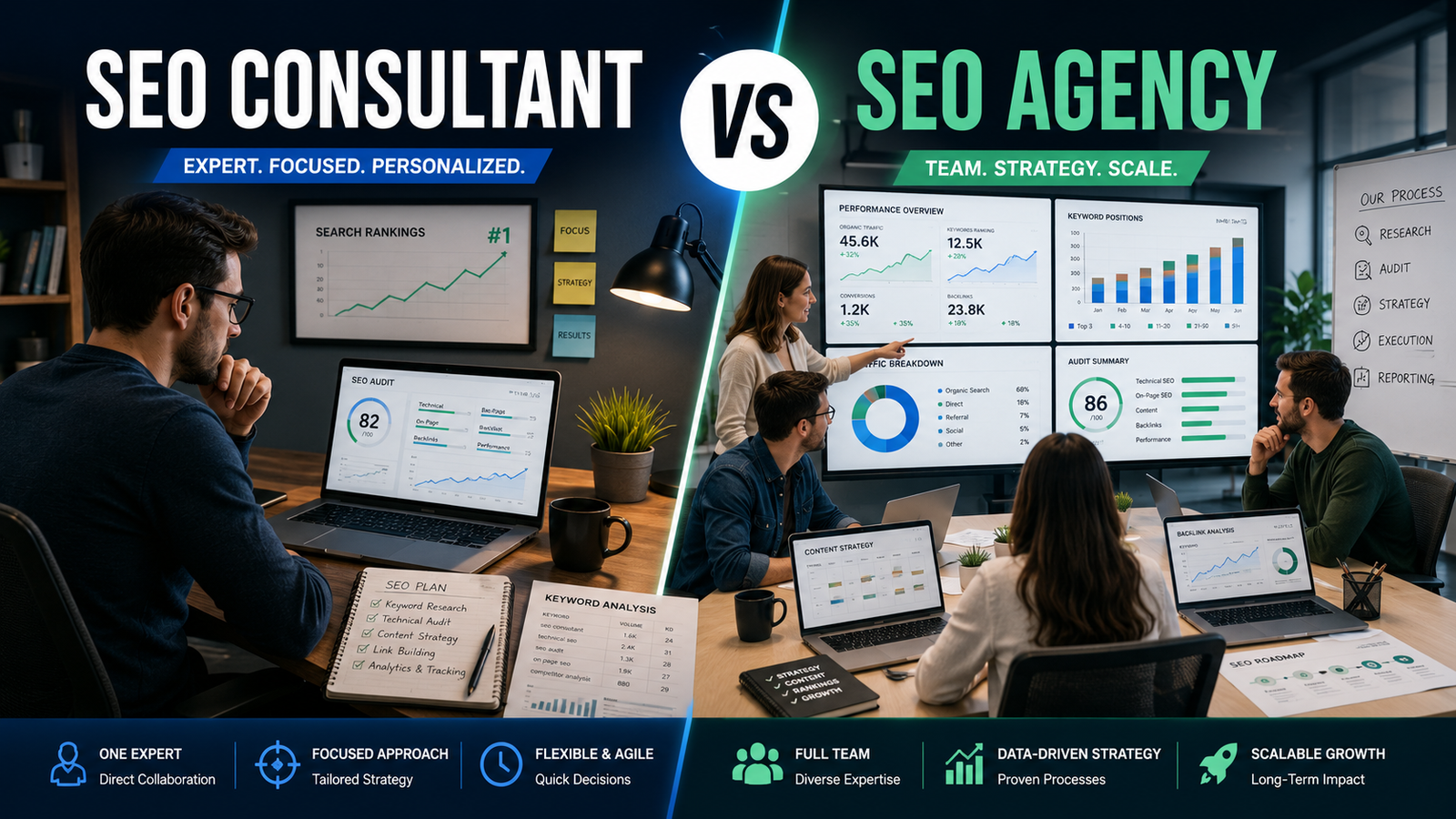
An SEO consultant provides strategic direction, audit findings, and prioritized recommendations without managing daily execution. An SEO agency manages the full program: strategy, content production, technical implementation, and reporting, typically through a retainer. The correct choice depends on whether in-house execution capacity already exists.
Key Takeaways
- Consultants direct a higher proportion of client spend toward execution because they carry no internal team overhead.
- Agencies allocate a portion of retainer value to internal roles account management, project coordination, junior staff — before execution begins.
- Onboarding duration differs structurally: consultant engagements typically begin execution within one to two weeks; agency engagements typically require thirty to ninety days for account setup, access provisioning, and internal alignment.
- Business size and internal marketing capacity determine which model produces higher return, not price alone.
What Is an SEO Consultant
An SEO consultant is an individual practitioner who diagnoses search performance issues and provides a strategic plan for resolving them. Consultants typically produce four deliverables: a technical audit, a keyword and content gap analysis, a prioritized action plan, and periodic strategic reviews. A consultant does not typically implement changes to a content management system, write content at scale, or manage outreach campaigns directly. The role exists to transfer expertise to an existing team, not to replace one.
Consultants commonly enter the field after several years working inside agencies or in-house marketing departments. This background provides pattern recognition across multiple industries and website structures, which supports faster diagnosis of recurring technical and content issues.
What Is an SEO Agency
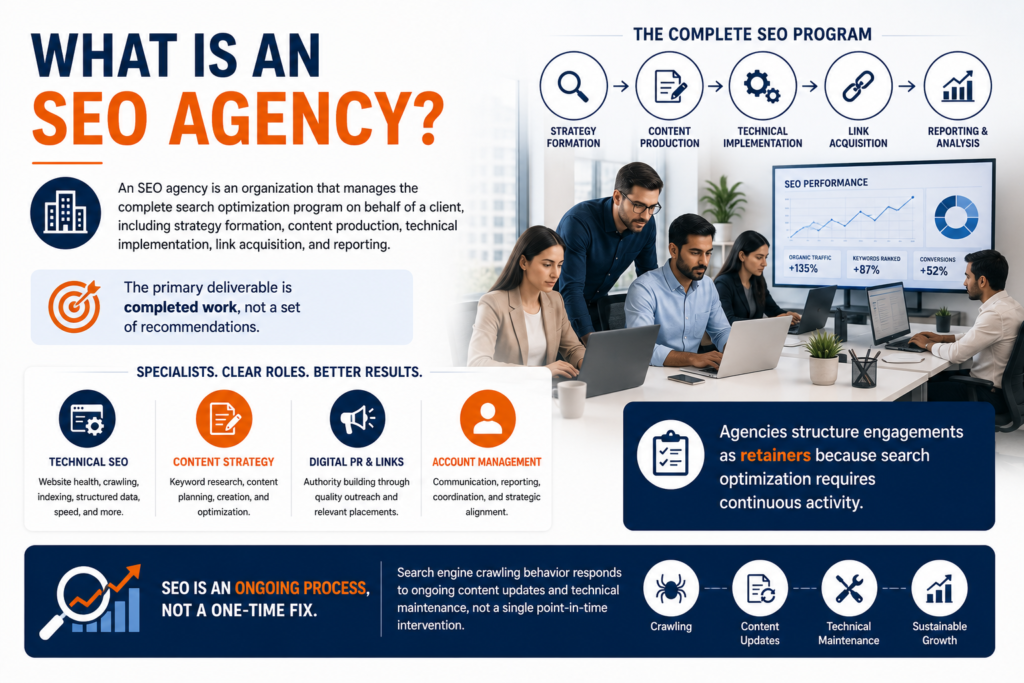
An SEO agency is an organization that manages the complete search optimization program on behalf of a client, including strategy formation, content production, technical implementation, link acquisition, and reporting. Agencies employ specialists across defined roles: technical SEO, content strategy, digital PR, and account management. The primary deliverable is completed work, not a set of recommendations.
Agencies structure engagements as retainers because search optimization requires continuous activity. Search engine crawling behavior responds to ongoing content updates and technical maintenance, not a single point-in-time intervention.
SEO Consultant vs SEO Agency: 7 Key Differences
An SEO consultant and an SEO agency can both improve organic visibility, but they usually provide different levels of strategy, execution and operational support. A consultant often works as a senior adviser who diagnoses problems, defines priorities and guides internal teams. An agency normally manages a broader set of ongoing activities through a team of specialists. The better option depends on the business’s internal resources, website complexity, budget and need for implementation.
1. Strategic Advice vs Full-Service Execution
An SEO consultant usually focuses on diagnosis, strategy and decision-making. They may audit the website, identify ranking barriers, define a roadmap and advise the marketing or development team on what to implement. This model works best when the business already has writers, developers and marketers who can execute the recommendations.
An SEO agency is more likely to manage both strategy and implementation. Its scope may include technical SEO, content production, on-page optimisation, link acquisition, local SEO and reporting. This reduces the client’s coordination burden, but the agency must clearly state which tasks it completes internally and which activities require separate development or content budgets.
2. Individual Expertise vs Multidisciplinary Team
A consultant’s value is usually concentrated in one person’s knowledge and experience. Businesses can work directly with the specialist responsible for the diagnosis and recommendations. This can improve clarity and reduce the risk of important decisions being filtered through account managers.
An agency provides access to several disciplines. A campaign may involve a technical SEO specialist, content strategist, writer, outreach professional, developer and data analyst. This broader expertise is useful for complex campaigns, but only when those specialists are genuinely involved. Some agencies sell senior expertise during the proposal stage and assign most delivery work to junior staff.
3. Advisory Capacity vs Production Capacity
An SEO consultant can often identify the highest-impact actions quickly, but may have limited capacity to produce large volumes of content, implement technical changes or manage outreach. Their role may end after recommendations, training or quality assurance.
An SEO agency normally has greater production capacity. It can work on multiple page groups, content assets, locations and technical tasks at the same time. This makes an agency more suitable for ecommerce, enterprise, multilingual and multi-location campaigns. However, greater output does not automatically mean greater value. Poorly prioritised production can increase cost without improving qualified traffic or revenue.
4. Direct Access vs Account Management
Businesses usually communicate directly with an SEO consultant. The person attending meetings is often the same person reviewing data and making recommendations. This can shorten decision paths and make technical discussions more precise.
An agency commonly assigns an account manager or project manager as the main contact. This creates a structured communication process, but it may separate the client from the specialists completing the work. Before hiring an agency, the business should confirm who will manage the strategy, who will perform the technical and content work and whether specialists will attend important meetings.
5. Pricing Structure and Overall Cost
SEO consultants may charge by the hour, day, project or monthly advisory retainer. Their fees can be high when they provide senior specialist expertise, but the total engagement may cost less because the client is not paying for a full delivery team. Additional costs arise when the business needs external writers, developers or link-building support.
SEO agencies usually charge a monthly retainer or fixed campaign fee. The price may cover several team members, project management, tools, production and reporting. Agency pricing is often higher, but it may be more economical than hiring and coordinating multiple independent providers. Businesses should compare the complete delivery scope rather than the base fee alone.
6. Flexibility vs Structured Processes
A consultant can usually adapt quickly to a specific technical problem, migration, traffic decline or strategic question. The engagement can be narrow and customised without requiring the client to purchase unrelated services. This flexibility is useful when the business has one defined problem or needs an independent second opinion.
An agency generally works through established workflows, production calendars, approval systems and reporting cycles. These processes can improve consistency and continuity, especially across large campaigns. The limitation is that rigid packages may include low-priority tasks or restrict changes in direction. A strong agency adjusts its process to the website’s actual needs rather than forcing every client into the same delivery template.
7. Internal Ownership vs Outsourced Campaign Management
Hiring a consultant normally requires greater internal ownership. The business must assign staff to implement recommendations, approve changes, provide data and coordinate development. This model can strengthen internal SEO capability because the consultant transfers knowledge and helps the team make better decisions over time.
Hiring an agency transfers more campaign management and execution to an external provider. This is useful when the business lacks an internal SEO team or cannot manage several workstreams. However, the client must still provide approvals, subject-matter expertise and technical access. Outsourcing SEO does not remove the need for internal involvement, especially when recommendations affect products, legal requirements, brand positioning or website systems.
Which Option Is Better for Your Business?
An SEO consultant is often the better choice when the business has an internal marketing or development team, needs senior strategic guidance or wants an independent audit before making a major investment. Consultants are also useful for website migrations, traffic-loss investigations, enterprise governance and quality assurance.
An SEO agency is usually more suitable when the business needs ongoing implementation across technical SEO, content, local search, authority building and reporting. Agencies can provide greater execution capacity, but the business should verify team seniority, deliverables, communication access and implementation responsibility before signing a contract.
The decision should not be based only on provider size. It should be based on whether the business needs advice, execution or a combination of both.
Cost Efficiency
| Model | Typical Share of Spend on Execution | Typical Share on Overhead |
| Independnet Consultant | 90-100% | 0-10% |
| Agency Retainer | 40-70% | 30-60% |
Agency overhead in this context refers to account management, project coordination, sales commission allocation, and administrative cost embedded in a retainer fee. Independent consultants carry no comparable internal staffing layer, so a larger proportion of the fee funds direct strategic and technical work.
For a monthly budget of $5,000, a 30–60% overhead allocation at an agency represents $1,500 to $3,000 directed to internal operations before any optimization work occurs on the client’s website. This is a structural feature of team-based service delivery, not an indication of poor management.
Speed to Execution
How long does SEO onboarding typically take
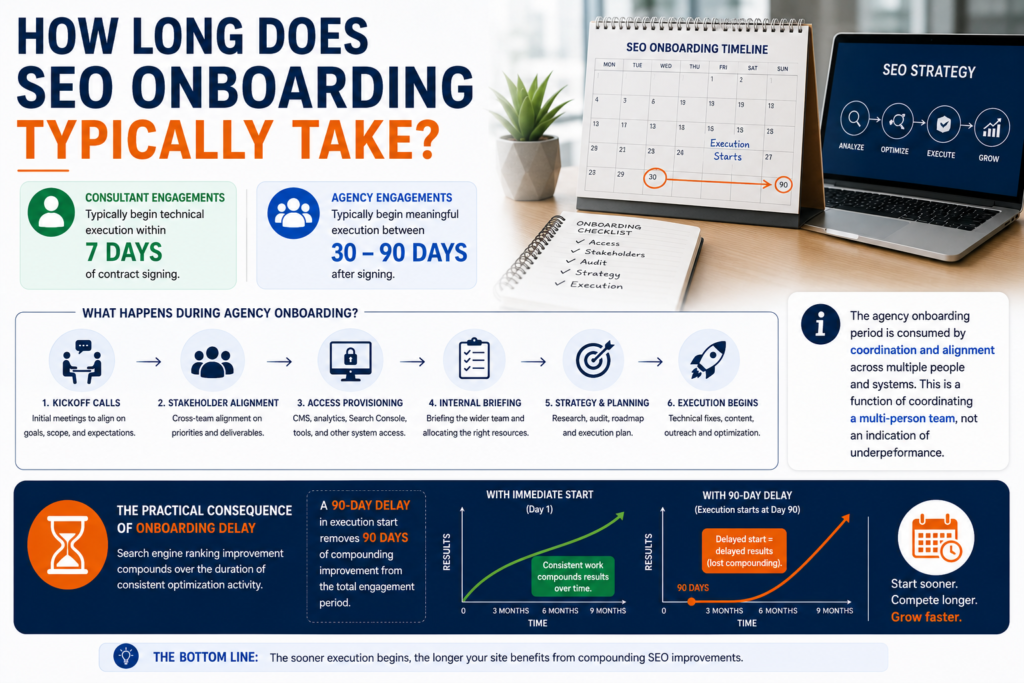
Consultant engagements typically begin technical execution within seven days of contract signing; agency engagements typically begin meaningful execution between thirty and ninety days after signing.
The agency onboarding period is consumed by kickoff calls, stakeholder alignment meetings, CMS and analytics access provisioning, and internal briefing processes across multiple team members. This is a function of coordinating a multi-person team, not an indication of underperformance.
The practical consequence of onboarding delay is time-based, not merely procedural. Search engine ranking improvement compounds over the duration of consistent optimization activity. A ninety-day delay in execution start removes ninety days of compounding technical and content improvement from the total engagement period.
Output Quality: Depth Versus Volume
Two content production models exist: high-intent, conversion-focused pages produced in smaller volume, and broad informational content produced at higher volume. Research on B2B SEO and buyer behavior consistently identifies bottom-of-funnel comparison and solution pages as higher-converting content types relative to general informational articles, because visitors to these pages have already progressed through initial research stages.
A provider compensated per deliverable has a structural incentive to increase content volume, since deliverable count is a visible measure of retainer activity. A provider compensated on outcome has a structural incentive to prioritize pages with direct commercial relevance, regardless of total page count.
Neither incentive structure is inherently dishonest. Both reflect how the engagement is measured and billed.
Accountability and Reporting
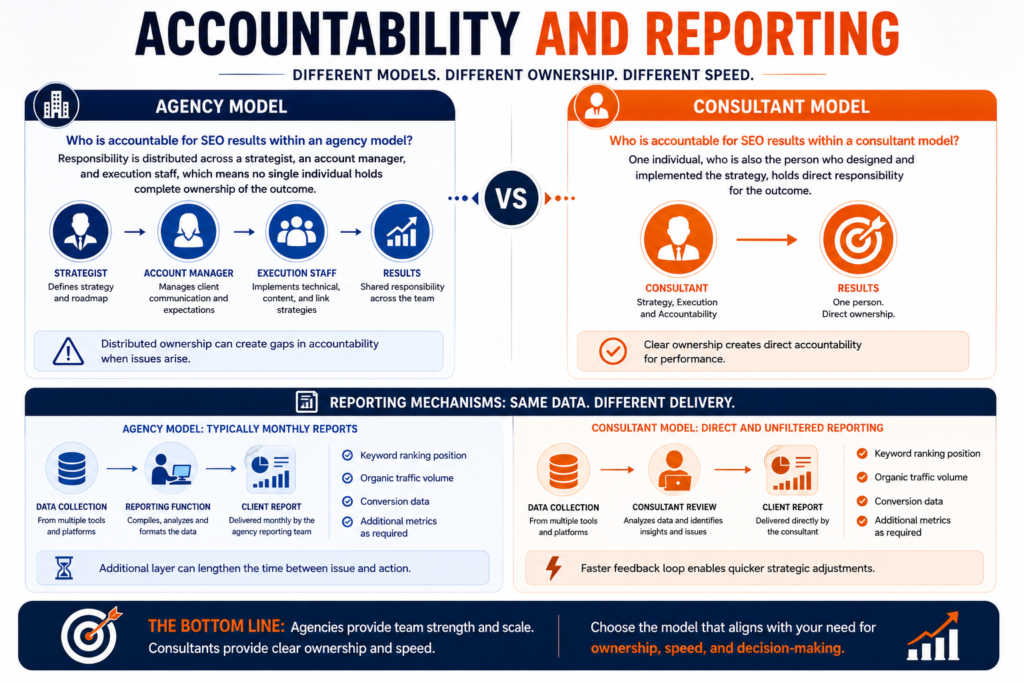
Reporting mechanisms differ by model. Agencies typically provide monthly reports covering keyword ranking position, organic traffic volume, and conversion data, generated by a dedicated reporting function. Consultants typically provide the same categories of data directly, without an intermediary reporting layer, which shortens the interval between a performance issue and a strategic adjustment.
AI Search and Answer Engine Optimization Capability
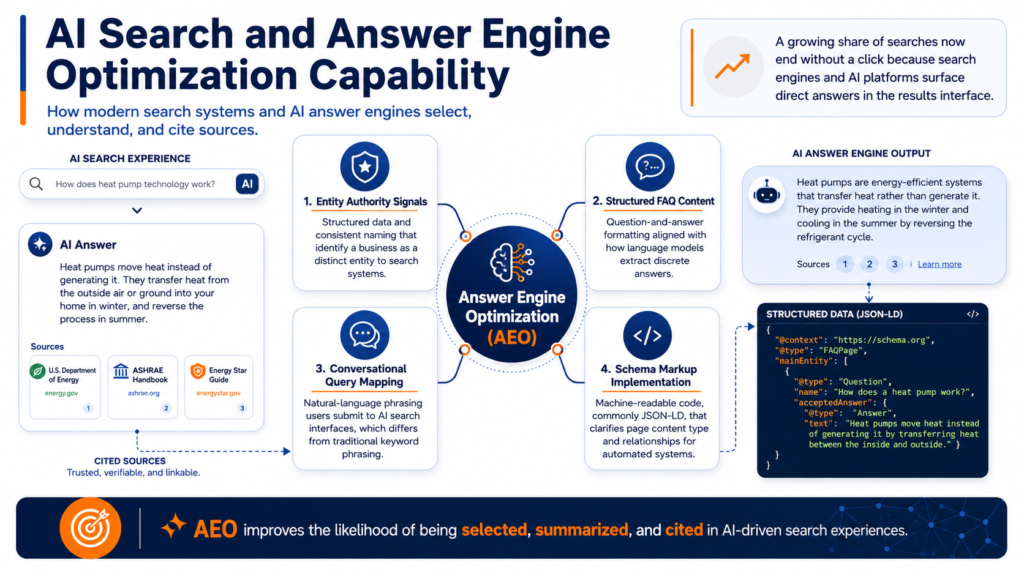
Search behavior research indicates a substantial share of search queries now conclude without a click to an external website, as search engines and AI platforms surface direct answers within the results interface. This shift has created a distinct optimization discipline, commonly referred to as Answer Engine Optimization (AEO), which addresses how large language models select and cite sources in conversational responses.
AEO includes four measurable components:
- Entity authority signals structured data and consistent naming that identify a business as a distinct entity to search systems.
- Structured FAQ in Content SEO question-and-answer formatting aligned with how language models extract discrete answers.
- Conversational query mapping identifying the natural-language phrasing users submit to AI search interfaces, which differs from traditional keyword phrasing.
- Schema markup implementation machine-readable code (commonly JSON-LD) that clarifies page content type and relationships for automated systems.
This discipline is recent relative to traditional SEO, and provider capability in this area varies significantly. A provider’s AEO capability can be verified by requesting citation data from AI search platforms for existing clients, rather than accepting a general claim of expertise
Access to Breadth of Expertise
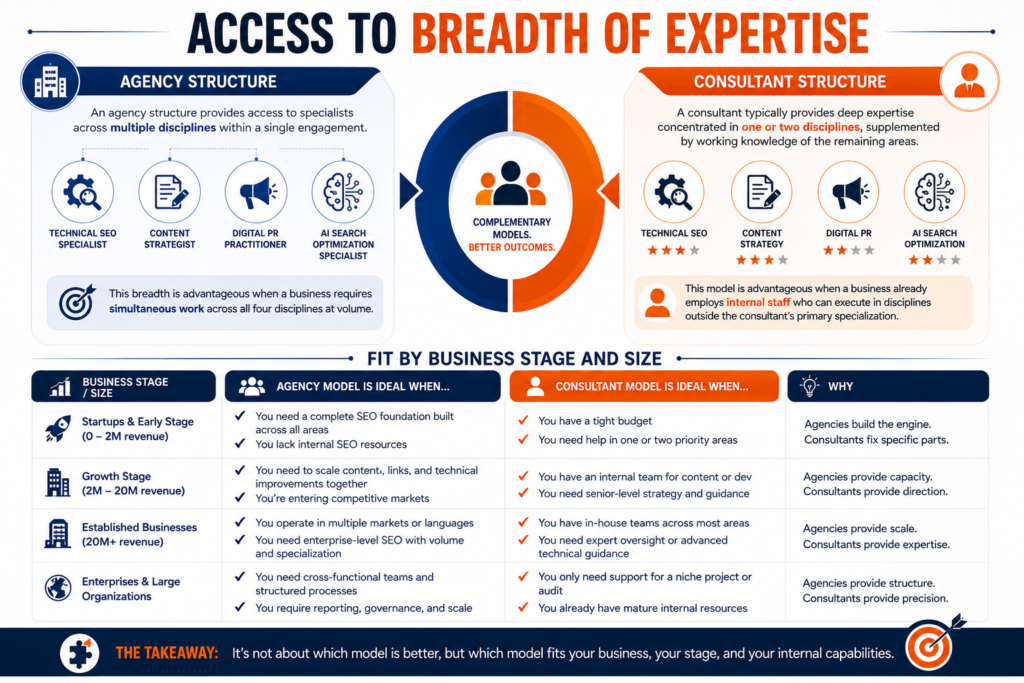
An agency structure provides access to specialists across multiple disciplines within a single engagement: a local SEO specialist, a content strategist, a digital PR practitioner, and increasingly, a specialist in AI search optimization. This breadth is advantageous when a business requires simultaneous work across all four disciplines at volume.
A consultant typically provides deep expertise concentrated in one or two disciplines, supplemented by working knowledge of the remaining areas. This model is advantageous when a business already employs internal staff who can execute in disciplines outside the consultant’s primary specialization.
Fit by Business Stage and Size
| Business Profile | Model More Likely to Produce Higher ROI | Structural Reason |
| No existing in-house marketing team | Agency | Provides both direction and execution capacity |
| Existing in-house team, limited SEO expertise | consultant | Upskills existing staff without funding duplicate execution capacity |
| Enterprise scale, 100+ content pieces monthly required | Agency | Provides parallel production capacity a single consultant cannot match |
Pricing Comparison
United Kingdom day rates for experienced independent SEO practitioners typically range from £600 to £1,500 per day, depending on specialization and verifiable track record. UK agency retainers for equivalent small-business scope typically range from £800 to £3,000 per month. In markets Pricing SEO in US dollars, senior independent consultants typically charge between $6,000 and $30,000 per month depending on engagement scope, a range comparable to mid-tier agency retainers at similar budget levels.
Price alone does not determine value at a given budget level. At comparable monthly spend, the material difference is the proportion of that spend allocated to direct execution versus internal overhead, addressed in Section 5.
A secondary cost consideration applies to the consultant model: recommendations for new software tools or staff training represent additional, sometimes unbudgeted expense, and implementation responsibility remains with the client’s internal team. If that team lacks capacity to implement recommendations, the value of the consultancy engagement is not realized regardless of the quality of the strategy produced.
When to Choose a Consultant
A consultant engagement is the structurally appropriate choice when the following conditions apply:
- An in-house marketing team exists but lacks SEO-specific expertise.
- The business requires senior level strategic ownership without the cost of a full-time hire.
- Budget allocation efficiency the proportion of spend reaching direct execution is a primary decision factor.
- The business needs to retain internal control over CMS access and daily execution.
- A specific technical or ranking problem requires diagnosis rather than ongoing program management.
When to Choose an Agency
An agency engagement is the structurally appropriate choice when the following conditions apply:
- No in-house marketing or SEO execution capacity exists.
- Content production requirements exceed 100 pieces per month.
- The business requires consolidation of SEO, PPC, and creative production under a single vendor.
- Procurement requirements mandate contracting with a vendor organization rather than an individual contractor.
- Twenty-four-hour coverage or parallel campaign execution across multiple markets is required.
The Hybrid Option: One-Time SEO Audits
An independent SEO audit is a hybrid deliverable: a one-time consultancy output that produces a prioritized action plan without an ongoing execution relationship. This model is appropriate under three conditions: an existing strategy is underperforming and requires independent diagnosis, a business is switching providers and requires a baseline performance assessment, or a technical incident has affected organic performance and requires diagnosis before a remediation plan is implemented.
An SEO audit differs from a full consultancy retainer in duration and scope: it is bounded to a single deliverable rather than an ongoing advisory relationship.
Real-World Outcomes
Quantified case outcomes provide a more reliable basis for decision-making than provider claims alone. When evaluating any published case study, three data points indicate reliability: a defined starting baseline, a defined measurement period, and a named, verifiable client or engagement.
Request the following from any provider under consideration, regardless of model: baseline organic traffic and keyword Research data prior to engagement start, the measurement period over which improvement is claimed, and the specific metric used to attribute business outcomes (leads, sign-ups, or revenue) to organic search activity.
FAQS
What is the main difference between an SEO consultant and an SEO agency?
An SEO consultant is usually an individual specialist who provides strategy, audits and recommendations. An SEO agency has a wider team that can manage strategy, technical SEO, content, link building, local SEO and reporting.
Is an SEO consultant cheaper than an SEO agency?
An SEO consultant is often cheaper because they have lower operating costs. However, the final cost depends on their experience, project complexity and whether additional specialists are required.
3. Should a small business hire an SEO consultant or an SEO agency?
A small business with a limited budget and an internal team may benefit from an SEO consultant. A business that needs complete implementation, ongoing content and technical support may be better suited to an SEO agency.
4. Can an SEO consultant deliver the same results as an SEO agency?
An experienced consultant can produce strong results for focused projects. However, one consultant may have limited capacity when a campaign requires developers, writers, designers, outreach specialists and local SEO experts.
How do I choose between an SEO consultant and an SEO agency?
Choose based on your budget, website size, internal resources and required services. Hire a consultant for specialist guidance or oversight. Hire an agency when you need a team to plan, implement and manage the entire SEO campaign.
Who provides more personalised SEO support: a consultant or an agency?
An SEO consultant usually provides more direct, one-to-one communication. An agency may involve account managers and multiple specialists, which can provide broader expertise but less direct access to the person completing each task.
Is an SEO agency better for large websites?
An SEO agency is often more suitable for large websites because it can assign specialists to technical SEO, content, digital PR, analytics and development. Large websites usually require more resources than one consultant can provide.
Can an SEO consultant work with an internal marketing team?
Yes. An SEO consultant can audit the website, develop the strategy, train the internal team and review implementation. This model works well when the business already has writers, developers and marketing staff.
Which option is better for ongoing SEO management?
An SEO agency is generally better for ongoing execution because it has a larger team and more operational capacity. A consultant may be more suitable for strategic supervision, periodic audits or specialised advice.
What questions should I ask before hiring an SEO consultant or agency?
Ask about relevant industry experience, campaign processes, reporting methods, communication, deliverables, contract terms and previous results. Avoid providers that guarantee first-position rankings or cannot explain how their work supports leads, sales or revenue.