
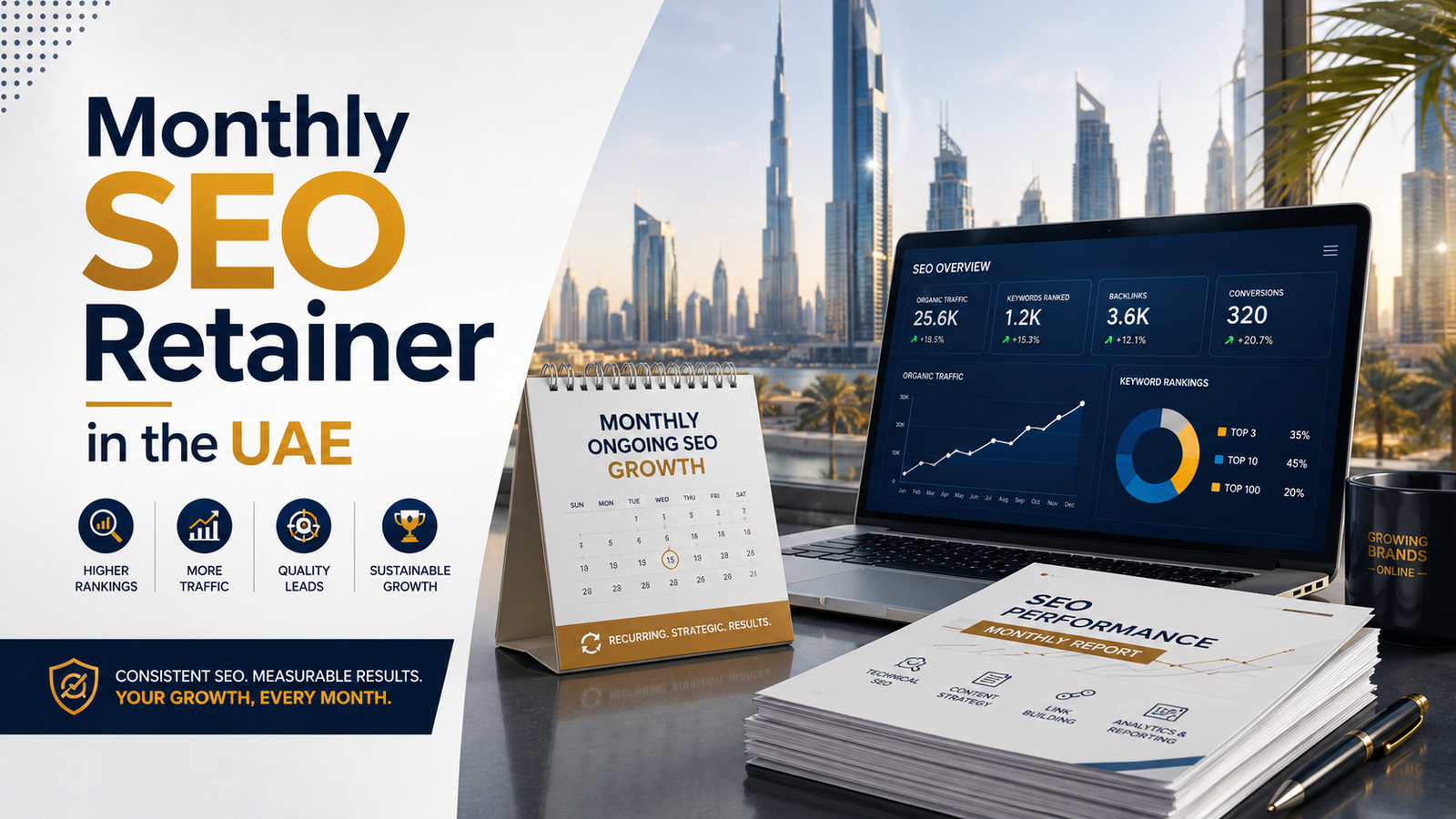
A monthly SEO retainer in the UAE is an ongoing agreement in which an SEO agency or consultant manages technical SEO, content, local visibility, authority development, conversion tracking and performance measurement for a fixed monthly fee.
Indicative monthly SEO retainer budgets in the UAE often range from AED 2,500 to AED 6,000 for focused local campaigns, AED 6,000 to AED 15,000 for established small and medium-sized businesses, and AED 15,000 to AED 50,000 or more for enterprise, multilingual or multi-location campaigns.
The monthly fee alone does not determine whether the service delivers value.
A serious SEO retainer should not use the calendar as the strategy.
Month 1 should not automatically mean an audit. Month 3 should not automatically mean content production. Month 5 should not automatically mean link building.
The campaign should move forward only when the current growth constraint has been reduced enough for the next layer of SEO work to create measurable commercial value.
A stronger monthly SEO operating sequence is:
Evidence → Decision Gate → Resource Allocation → Implementation → Validation → Next Constraint
The first six months should therefore be treated as changing operating states rather than a fixed production schedule.
What Is a Monthly SEO Retainer
A monthly SEO retainer is a recurring commercial agreement that provides continuous access to SEO strategy, implementation, analysis and reporting.
Unlike a one-time SEO audit, a retainer supports ongoing work as search demand changes, competitors improve their websites, Google recrawls pages and new technical or commercial constraints emerge.
A monthly SEO retainer in the UAE commonly includes:
- Technical SEO monitoring and implementation
- Keyword and search-intent research
- On-page SEO
- Commercial landing-page optimisation
- Content planning and development
- Internal linking
- Local SEO
- Google Business Profile optimisation
- Backlink and authority analysis
- Digital PR or outreach
- Competitor monitoring
- Conversion tracking
- Lead attribution
- Monthly reporting
- Strategic prioritisation
The exact allocation should change according to the website’s current condition and commercial objectives.
A local service company in Dubai may require Google Maps visibility and location-page improvements. An ecommerce business may require category architecture, product indexing and organic revenue tracking. A B2B company may need solution pages, industry pages, case studies and longer lead-attribution windows.
This is why a fixed package containing the same activities every month often fails to address the real constraint.
How Much Does a Monthly SEO Retainer Cost in the UAE

There is no official UAE SEO pricing tariff. Agencies, consultants and in-house specialists price campaigns according to scope, competition, implementation requirements and resource levels.
The following figures provide practical planning ranges rather than guaranteed market prices.
| Businesss or compaign type | Indicative monthly retianer |
| Startup or limited local compaign | AED 1500-4000 |
| Small local business | AED 25000-6000 |
| Establishes SME | AED 6000-15000 |
| Competitive multi services compaign | AED 10000-25000 |
| Enterprise or multi services compaign | AED 15000-25000 |
| large interprise program | AED 20000-80000 |
A higher fee does not automatically indicate a stronger SEO campaign. A lower fee does not automatically indicate better value.
The important question is what resources, implementation responsibilities and commercial outcomes the retainer supports
Factors That Affect SEO Retainer Pricing in the UAE
Monthly SEO pricing normally depends on:
- Website size
- Current technical condition
- Number of services or products
- Number of target locations
- Industry competition
- Arabic and English requirements
- International SEO
- Content-production volume
- Development requirements
- Backlink or digital PR requirements
- Reporting complexity
- CRM and lead-attribution setup
- Approval and implementation responsibilities
A five-page local website targeting one area in Dubai does not require the same operating capacity as a multilingual ecommerce website with thousands of product URLs across the UAE and GCC.
8 Services Included in a Monthly SEO Retainer in the UAE
A monthly SEO retainer in the UAE usually combines technical maintenance, content development, on-page optimisation, authority building, local visibility, performance tracking and strategic planning. The exact scope depends on the website, industry, target locations and available budget. A credible retainer should define the activities, deliverables, implementation responsibilities and reporting method rather than promise a fixed number of rankings.
1. SEO Strategy and Monthly Campaign Planning
The retainer begins with an SEO strategy based on the company’s services, target customers, priority locations, commercial goals and competitive position. The SEO provider reviews current performance, identifies the most valuable opportunities and plans the work for the month. This may include selecting priority pages, assigning content tasks, scheduling technical fixes and deciding which keywords or markets require additional support. Monthly planning keeps the campaign focused on business outcomes instead of completing disconnected SEO tasks.
2. Technical SEO Monitoring and Maintenance
Technical SEO monitoring identifies conditions that may prevent search engines from crawling, rendering, indexing or understanding the website. The monthly scope may include checking crawl errors, broken links, redirects, canonical tags, XML sitemaps, robots directives, structured data, mobile usability and Core Web Vitals. The provider may also monitor changes caused by website updates, plugin installations, product additions or development releases. Complex technical corrections may require separate developer support, but the SEO retainer should identify the problem, explain its impact and provide clear implementation requirements.
3. Keyword Research and Search-Intent Mapping
Keyword research is not limited to creating a large spreadsheet of search terms. The provider groups search demand by service, problem, location, product, industry and buyer intent. Each keyword group is then mapped to an existing or planned page. This process helps prevent several pages from competing for the same topic and identifies gaps where the website lacks a suitable landing page. In UAE campaigns, keyword mapping may also account for Dubai districts, other Emirates, English and Arabic searches, industry terminology and local buying behaviour.
4. On-Page SEO Optimisation
On-page SEO improves the relevance, structure and usability of important website pages. Monthly work may include refining page titles, meta descriptions, headings, introductions, internal links, image attributes, content sections and calls to action. The provider may also improve entity coverage, answer common customer questions and align each page with a clear search intent. Effective on-page optimisation does not involve inserting the same keyword repeatedly. It strengthens the page’s ability to explain the service, satisfy the user’s query and guide visitors towards an enquiry or purchase.
5. SEO Content Creation and Updating
A monthly retainer may include new service pages, location pages, blog articles, product-category content, case studies, FAQs or industry guides. Existing content may also be consolidated, expanded, corrected or refreshed when it no longer matches search intent. The amount of content depends on the campaign scope and the research required. A technical B2B article or regulated healthcare page generally requires more specialist input than a basic informational post. Content should support the website’s main commercial topics rather than increase the page count without a clear purpose.
6. Internal Linking and Website Architecture
Internal linking helps search engines discover important pages and understand the relationship between services, locations, industries and supporting content. The SEO provider may add contextual links, improve breadcrumb paths, connect related topics and reduce the number of clicks required to reach high-value pages. The retainer may also include recommendations for consolidating duplicate pages or restructuring weak service and location hierarchies. This work improves crawlability and distributes internal authority towards the pages most likely to generate qualified enquiries.
7. Local SEO and Google Business Profile Management
Businesses serving specific UAE locations may receive ongoing local SEO support. This can include Google Business Profile optimisation, category reviews, service updates, photo publishing, review monitoring, business-information checks and local ranking analysis. The campaign may also address citation consistency, duplicate listings and the relationship between the business profile and relevant website pages. Multi-location businesses require separate monitoring for each verified branch because every location has its own competitors, reviews, services and visibility patterns.
8. Authority Building, Reporting and Performance Analysis
A complete monthly retainer may include authority development through relevant backlinks, digital PR, business citations, partnerships and brand mentions. The provider should prioritise link relevance and source quality rather than sell a fixed quantity of low-value links. The retainer should also include reporting through tools such as Google Search Console, Google Analytics and rank-tracking platforms. Reports may cover visibility, clicks, landing-page performance, conversions, leads, completed work and unresolved risks. The purpose of reporting is to explain what changed, why it changed and which actions will be prioritised next.
What Should a Serious SEO Retainer Include?
A properly defined SEO retainer should state:
- Business objectives
- Priority workstreams
- Included deliverables
- Assigned specialists
- Implementation responsibilities
- Review frequency
- Data sources
- Success metrics
- Exclusions
- Dependencies
- Approval requirements
- Contract and cancellation terms
The retainer should also explain how priorities will change when new evidence appears.
A list of recurring activities is not a complete SEO strategy. The provider must connect each activity with a diagnosed constraint, a commercial consequence and a measurable outcome.
Why Fixed Monthly SEO Packages Often Underperform
Many SEO packages are organised around deliverable volume.
For example:
- Four articles per month
- Ten backlinks per month
- One technical audit
- Twenty keywords tracked
- One monthly report
These deliverables are easy to count, but they do not prove that the campaign is addressing the website’s largest commercial constraint.
Four new articles add little value when priority service pages are excluded from Google’s index. Ten new backlinks add little value when the target landing pages do not match search intent. More organic traffic adds little value when calls, forms and sales are not tracked correctly.
A mature SEO retainer asks a different question:
Where is the website currently losing the greatest amount of qualified organic search opportunity?
The answer determines where the next month’s resources should be allocated.
A Six-Month SEO Retainer Operating Model
Month 1: Establish a Commercial Decision Baseline
The first month should identify where organic growth is being lost.
The SEO provider should examine:
- Technical condition
- Crawling and indexation
- Website architecture
- Commercial rankings
- Traffic distribution by page type
- Search demand
- Competitor coverage
- Backlink gaps
- Local visibility
- Google Business Profile optimization
- Conversion tracking
- Lead attribution
- Arabic and English search coverage
- Landing-page performance
The primary output should be a constraint register, not merely an audit report.
A constraint register connects each SEO issue with its commercial consequence.
| Constrait | Example | Businesss consequences |
| Searhc eligibity | Important pages are not indexed | Relevant search demand cannot be captured |
| Architichture | Services and locations are poorly connected | Page hierarchy and internal relevance remain weak |
| Relevance | Pages do not match commercial search intent | Visibility grows for low-value or irrelevant queries |
| Authority | Competitors have stronger relevant links | Priority pages remain below stronger competitors |
| Conversion | Traffic reaches weak landing pages | More visits do not produce proportional enquiries |
| Measurement | Leads are not attributed correctly | SEO return cannot be evaluated reliably |
| local visibilty | Business information and location signals are weak | The company loses calls, directions and local bookings |
The first decision gate is:
Which constraint currently blocks the largest amount of commercial search opportunity?
That answer should determine the next allocation of SEO capacity.
Month 2: Remove the Highest-Dependency Bottleneck
The second operating state should focus on work that enables other SEO activities to succeed.
This does not mean fixing every issue discovered during the audit.
A website may contain:
- 200 missing meta descriptions
- 1,000 duplicate filtered URLs
- A canonical conflict affecting commercial service pages
- Broken call tracking
All four are problems, but they do not have equal dependency value.
The canonical conflict may prevent important service pages from consolidating the correct ranking signals. Duplicate URLs may create crawl inefficiency. Broken call tracking prevents the business from measuring commercially valuable enquiries.
Missing meta descriptions matter, but they may not be the highest-priority constraint at that stage.
The Month 2 decision gate is:
When the answer is no, aggressive content expansion is premature.
Priority work may include:
- Correcting indexation directives
- Resolving canonical conflicts
- Improving crawl paths
- Removing redirect chains
- Consolidating duplicate URLs
- Repairing internal links
- Improving mobile performance
- Correcting structured data
- Connecting analytics and call tracking
- Defining conversion events
- Validating Google Search Console data
Technical SEO work should be prioritised according to commercial dependency rather than issue count.
Month 3: Build Search Coverage Around Revenue Architecture
Once the primary eligibility and measurement blockers are controlled, the campaign should focus on commercial search coverage.
The objective is not to publish the largest possible number of URLs.
The objective is to create the correct relationship between:
Search Demand → Search Intent → Page Type → Commercial Offer → Conversion Path
Revenue Architecture for a Service Business
A service-based website may require relationships between:
Core Service → Specialist Service → Location → Problem → Comparison → Enquiry
For example, an aesthetic clinic may connect:
- Aesthetic treatments
- Laser hair removal
- Laser hair removal in Dubai
- Causes of unwanted hair growth
- Laser versus waxing
- Consultation booking
Each page has a separate role. The pages should support one another rather than compete for the same query.
Revenue Architecture for Ecommerce
An ecommerce website may require:
Category → Subcategory → Product Group → Product → Buying Guide → Transaction
For example:
- Skincare
- Acne skincare
- Salicylic acid products
- Individual cleanser
- Guide to choosing acne products
- Product purchase
Revenue Architecture for B2B Companies
A B2B website may require:
Solution → Industry → Use Case → Problem → Proof → Consultation
For example:
- Logistics software
- Cold-chain logistics
- Fleet temperature monitoring
- Product spoilage risk
- Case study
- Demonstration request
The Month 3 decision gate is:
Does every commercially important search-intent cluster have a suitable page with a defined role in the acquisition journey?
When the answer is no, resources should remain focused on:
- Keyword mapping
- Search-intent classification
- Website architecture
- URL consolidation
- Commercial landing-page development
- Internal linking
- Conversion-path design
Month 4: Expand Topic Depth Without Creating Content Inflation
By Month 4, many SEO campaigns make a predictable mistake: content production increases faster than the website can integrate new pages into its existing commercial architecture.
More content does not automatically produce stronger topical relevance.
Each supporting page should reinforce a defined relationship.
Problem Guide → Service Page
A problem guide explains the need addressed by a commercial service.
Buying Guide → Category Page
A buying guide supports product evaluation before a category or product decision.
Technical Guide → B2B Solution Page
A technical guide develops understanding around a specialised solution.
Local Guide → Location Page
A local guide supports legitimate geographic relevance where the business has a real operational relationship with that location.
Every content decision should fall into one of six actions:
Create → Improve → Consolidate → Redirect → Internally Link → Remove
This prevents uncontrolled content accumulation.
A website may contain hundreds of pages and still have weak topical architecture when:
- Several pages target the same intent
- Supporting pages have no internal relationship
- Blog content is disconnected from commercial services
- Thin pages dilute stronger pages
- Old URLs remain indexed without a purpose
- Location pages repeat the same generic text
- AI-generated pages add volume without new information
The Month 4 decision gate is:
Is new content SEO commercial architecture or merely increasing URL count?
A useful content plan should define:
- Target entity
- Search intent
- Page purpose
- Parent commercial page
- Internal-link destination
- Conversion role
- Evidence requirement
- Consolidation risk
Month 5: Validate Whether Authority Is the Real Constraint
Link building should not increase simply because the campaign has reached Month 5.
Authority development should receive a larger share of resources only when evidence shows that technical eligibility, page relevance, content coverage and internal architecture are no longer the dominant constraints.
A useful diagnostic sequence is:
Priority pages are indexed
Search intent is aligned
Content coverage is competitive
Internal linking is sufficient
Rankings repeatedly stall below stronger competitors
Authority may be the next constraint
At this point, the campaign may include:
- Backlink-gap analysis
- Publisher qualification
- Digital PR
- Expert contributions
- Original research
- Data-led assets
- Relevant outreach
- Industry relationship development
- Unlinked brand-mention recovery
- Strategic link reclamation
The objective should be authority-gap reduction, not link accumulation.
A campaign may acquire many links without improving its competitive position when those links are:
- Irrelevant to the subject
- Placed on low-quality pages
- Directed to the wrong URL
- Disconnected from the target search results
- Acquired from websites with no audience overlap
- Built only to satisfy a monthly quantity target
The Month 5 decision gate is:
Is authority work improving the competitive position of commercially important pages?
Authority should be measured through ranking movement, query expansion and commercial-page performance—not the number of links delivered in a report.
Month 6: Conduct a Constraint Migration Review
By Month 6, the campaign should determine whether the original bottleneck has moved.
SEO constraints migrate as previous problems are reduced.
For example:
Initial constraint: Important pages are not indexed
Technical correction: Indexation improves
New constraint: Commercial pages lack sufficient relevance
Content correction: Service coverage improves
New constraint: Stronger competitors continue to dominate the search results
Authority correction: Competitive strength increases
New constraint: Traffic grows but conversion performance remains weak
Conversion correction: Landing pages generate more enquiries
New constraint: Lead quality or attribution remains unreliable
The six-month review should examine:
- Visibility growth by commercial cluster
- Non-branded query expansion
- Ranking distribution
- Qualified organic traffic
- Conversion performance
- Call and form volume
- Lead quality
- Organic-assisted revenue
- Location-level performance
- Google Maps actions
- Arabic versus English performance
- Implementation delays
- Approval bottlenecks
- Authority gaps
- Measurement reliability
- Landing-page conversion rates
The output should be a constraint migration map.
| Original constraint | Evidence of improvement | New constraint | Nest allocation |
| Indexation | Priority URLs become indexed | Weak service coverage | Commercial page development |
| Weak content | Pages enter stronger ranking ranges | Authority gap | Digital PR and out reach |
| Low traffic | Qualified visit increase | Weak conversion | Landing page optimisation |
| Low lead volume | Enquiries increase | Poor lead quality | Intent refinement and CRM attribution |
| Weak local visibility | Map impression and action increase | Poor review conversion | Reputation and listing optimisition |
| Weak measurement | Call and formed are tracked | Unclear revenue value | CRM and sales data integration |
The Month 6 question should not be limited to:
Did organic traffic increase?
The stronger question is:
Where is commercial value being lost now compared with six months ago?
That answer should reset the next operating cycle.
The mature monthly SEO retainer therefore follows:
Diagnose → Prioritise → Implement → Validate → Measure → Reallocate
How SEO Retainer Performance Should Be Measured
Monthly should distinguish activity metrics from commercial performance.
Activity metrics explain what the agency completed. Performance metrics show whether the work changed business outcomes.
Visibility Metrics
- Indexed priority URLs
- Non-branded impressions
- Commercial keyword coverage
- Ranking distribution
- Local pack visibility
- Share of search visibility
- Arabic and English query growth
Engagement Metrics
- Qualified organic sessions
- Landing-page engagement
- Product or service-page visits
- Returning visitors
- Internal journey progression
Conversion Metrics
- Calls
- Form submissions
- WhatsApp enquiries
- Appointment bookings
- Consultation requests
- Ecommerce transactions
- Qualified leads
- Cost per organic lead
- Lead-to-opportunity rate
- nic-assisted pipeline
- Organic revenue
- Revenue by landing page
- Lead quality by search-intent cluster
- Customer acquisition cost
A report that only shows keyword positions and total traffic does not provide enough evidence to evaluate an SEO retainer.
Questions to Ask Before Signing an SEO Retainer
Before choosing an SEO agency in the UAE, ask:
- What is currently limiting our organic growth?
- Which workstream will receive priority first?
- What evidence supports that priority?
- Who will implement technical changes?
- Who will create or approve content?
- Are Arabic and English SEO included?
- Is local SEO included?
- How will calls, forms and sales be tracked?
- Which metrics will define success?
- How often will priorities be reviewed?
- What is excluded from the monthly fee?
- What happens when the original constraint changes?
- What is the minimum contract period?
- What are the cancellation terms?
- Who owns the content, accounts and data?
Clear answers reduce the risk of paying for recurring activity without commercial accountability.
Warning Signs in a Monthly SEO Package

Be cautious when a provider:
- Guarantees a number-one Google ranking
- Promises a fixed number of backlinks without quality criteria
- Starts content production before reviewing indexation and intent
- Reports traffic without conversions
- Does not provide access to analytics accounts
- Cannot explain implementation responsibilities
- Uses the same package for every business
- Creates large numbers of near-duplicate location pages
- Avoids discussing lead quality or revenue
- Refuses to explain where links will come from
- Treats monthly reports as the strategy
- Does not update priorities when evidence changes
The risk is not only wasted budget. Poor technical changes, low-quality content and manipulative links may create additional recovery work.
FAQS
What is a monthly SEO retainer?
A monthly SEO retainer is an ongoing agreement in which an agency or consultant provides continuous SEO strategy, implementation, monitoring and reporting for a recurring monthly fee. The work may include technical SEO, content, local SEO, internal linking, authority development and conversion measurement.
Why do UAE businesses use monthly SEO retainers?
SEO requires ongoing analysis because websites, competitors, customer demand and search results change. A monthly retainer gives UAE businesses continuous access to optimisation resources instead of limiting the work to a one-time audit or isolated project.
What is included in a monthly SEO retainer?
A typical retainer includes technical SEO, keyword research, search-intent mapping, on-page optimisation, content development, internal linking, local SEO, competitor analysis, authority development, conversion tracking and monthly reporting. The exact scope depends on the website and business objectives.
How much does a monthly SEO retainer cost in the UAE?
Focused local campaigns often fall between AED 2,500 and AED 6,000 per month. Established SME campaigns often range from AED 6,000 to AED 15,000. Enterprise, multilingual and multi-location campaigns may require AED 15,000 to AED 50,000 or more per month. These are planning ranges rather than fixed prices.
How much does SEO cost per month in Dubai?
SEO pricing in Dubai depends on competition, website size, target areas, content requirements and implementation scope. A small local company requires a different budget from a real estate portal, ecommerce store or multi-location healthcare provider.
How long does SEO take to show results?
Technical corrections may produce early changes within several weeks. Meaningful ranking and qualified-traffic growth often requires three to six months. Competitive campaigns commonly require six to twelve months or longer. The timeline depends on the website’s condition, authority, competition and implementation speed.
Is a monthly SEO retainer suitable for small businesses?
A focused retainer is suitable when the scope matches the available budget. Small businesses often receive greater value from prioritising a limited number of profitable services, target locations and conversion actions rather than attempting to compete across every keyword.
Does an SEO retainer include local SEO?
Local SEO may form part of the retainer when the business serves defined geographic areas. The work may include Google Business Profile optimisation, local landing pages, review signals, citations, service information, location relevance and local conversion tracking.
Does an SEO retainer include Google Business Profile optimisation?
It should be included when Google Maps and local search contribute to customer acquisition. The scope should clarify whether the agency manages categories, services, business information, posts, photos, reviews, landing-page connections and performance reporting.
Will I receive monthly SEO reports?
A professional retainer should include regular reporting. The report should connect completed work with visibility, qualified traffic, calls, forms, bookings, sales and the next strategic priority.