
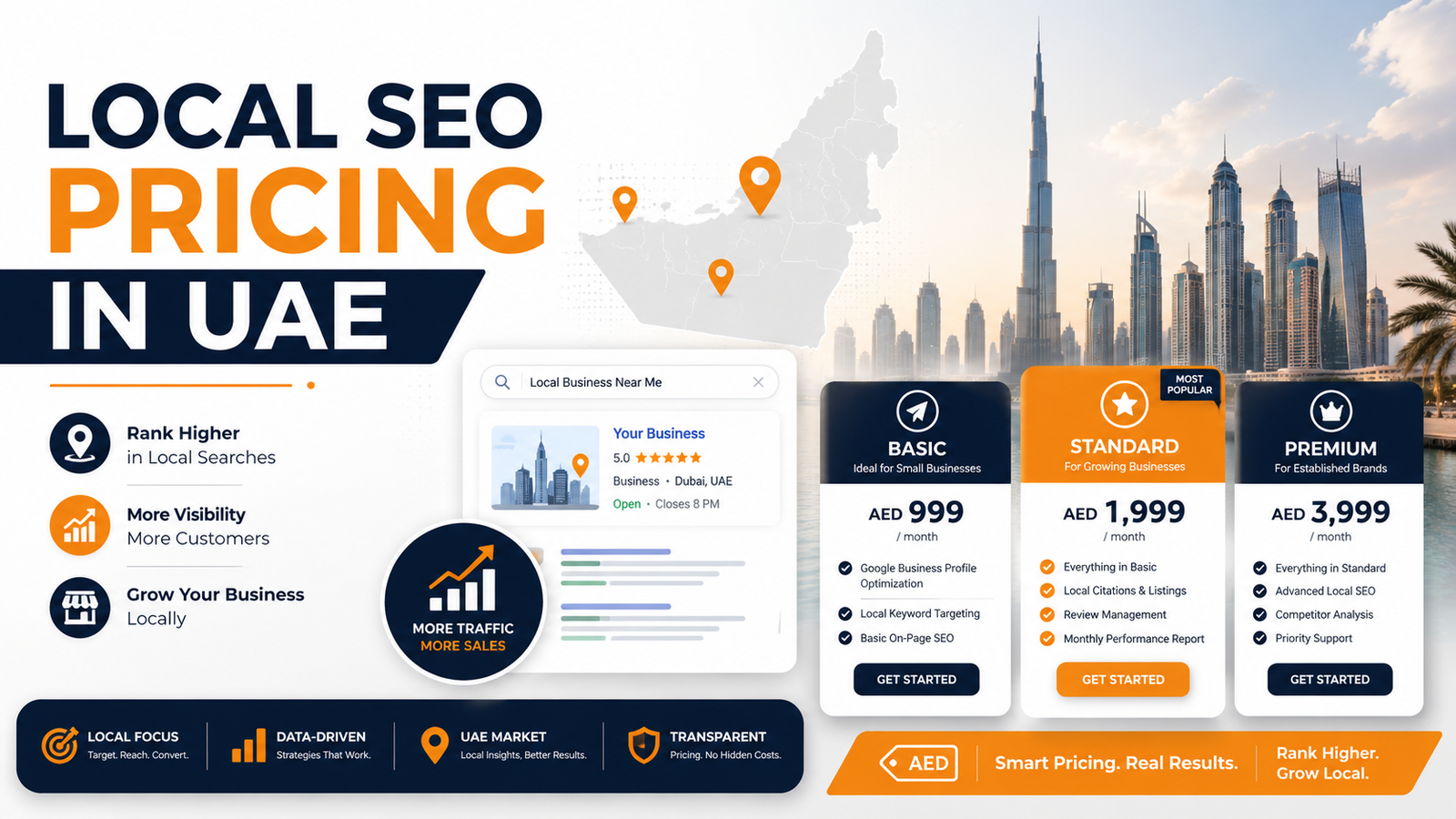
Local SEO pricing in the UAE commonly ranges from AED 1,500 to AED 15,000 or more per month.
A focused campaign for one location may cost between AED 1,500 and AED 3,000 per month. A growing service business targeting several competitive services may invest AED 3,000 to AED 7,000. Multi-location, multilingual, or highly competitive campaigns may require AED 7,000 to AED 15,000 or more.
These figures are planning ranges, not fixed market rates. Publicly advertised UAE packages vary significantly. Current examples include entry plans near AED 1,499, mid-level plans between AED 2,999 and AED 5,000, and broader competitive programs extending beyond AED 10,000 per month.
The more useful pricing formula is:
Business opportunity → Current visibility gap → Required assets → Implementation workload → Monthly investment
A low price is not automatically a good deal. It becomes expensive when the package does not contain enough work to improve visibility, attract qualified enquiries, or support measurable revenue.
Local SEO Pricing in the UAE at a Glance
| Campaing level | Indicative monthly budget | Suitable for | Typical focus |
| local foundation | AED 1500-3000 | One location, limited services | Google Business Profile, keyword mapping, core page optimization and basic reporting |
| local growth | AED 3000-7000 | Growing service businesses | Technical fixes, service content, local pages, citations, reviews and conversion tracking |
| competative or multilocation | AED 7000-15000 | Clinics, law firms, property companies, home-service brands | Location architecture, content production, authority development and branch-level reporting |
| Enterprise local search | custom pricing | Franchises, national brands | Central governance, Arabic and English SEO, multiple profiles, integrations and advanced attribution |
The bands overlap because campaign difficulty cannot be calculated from the number of keywords or pages alone.
A five-page website in a competitive legal or healthcare market may require more research, authority development, compliance review, and conversion work than a twenty-page website in a less competitive industry.
What Does Local SEO Pricing Actually Pay For
Local SEO pricing represents the cost of closing the gap between a business’s current visibility and the position it needs to compete for commercially valuable searches.
That gap normally exists across five connected assets:
Website → Google Business Profile → Local reputation → External authority → Conversion measurement
A campaign costs more when several assets require repair or development at the same time.
For example:
- One business may have an established Google Business Profile but weak service pages.
- Another may have useful website content but inconsistent directory information.
- A third may have a technically healthy website but few reviews and weak local authority.
- A multi-branch company may have strong head-office visibility but poorly optimized branch profiles.
These businesses do not require the same package.
Applying one generic checklist to every business wastes money because it treats different constraints as though they were the same problem.
Why Do Local SEO Prices Vary Between UAE Businesses
Local SEO prices vary because businesses compete in different markets, begin from different positions, and require different levels of execution.
The main pricing factors are:
- Geographic coverage
- Industry competition
- Customer and lead value
- Website condition
- Google Business Profile condition
- Content SEO and authority gaps
- Implementation responsibility
- Measurement complexity
Understanding these factors makes it easier to compare proposals without relying on price alone.
1. Geographic Coverage
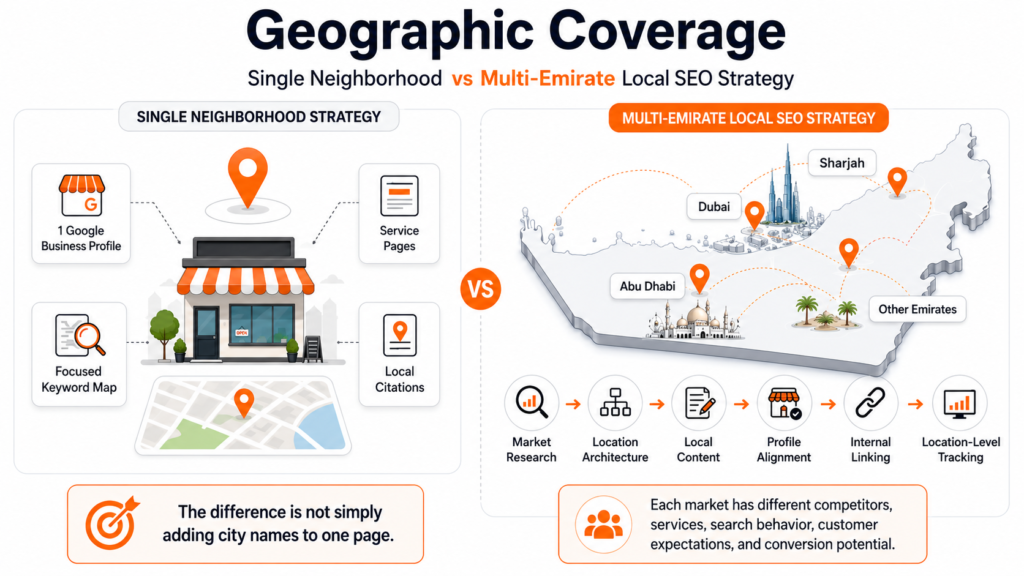
A business targeting one neighborhood may need one main Google Business Profile, several service pages, a focused keyword map, and a limited set of local citations.
A company targeting Dubai, Abu Dhabi, Sharjah, and other emirates may require:
Market research → Location architecture → Local content → Profile alignment → Internal linking → Location-level tracking
The difference is not simply adding three city names to the same page.
Each market may contain different competitors, services, search behavior, customer expectations, and conversion potential. A valid multi-emirate strategy therefore requires more research, production, implementation, and quality control.
2. Industry Competition
Competition is not measured only by the number of businesses appearing in Google.
A serious competitor may have:
- Detailed service pages
- Strong Google review profiles
- Established location pages
- Relevant backlinks and media mentions
- Accurate directory listings
- Strong branded search demand
- Fast mobile performance
- Clear conversion paths
- Years of accumulated authority
Closing one small content gap can be inexpensive. Closing technical, content, reputation, and authority gaps at the same time requires a larger operating scope.
This is why local SEO for a low-competition repair service may cost less than SEO for a dental clinic, law firm, property company, or high-value contractor in the same area.
3. Customer and Lead Value
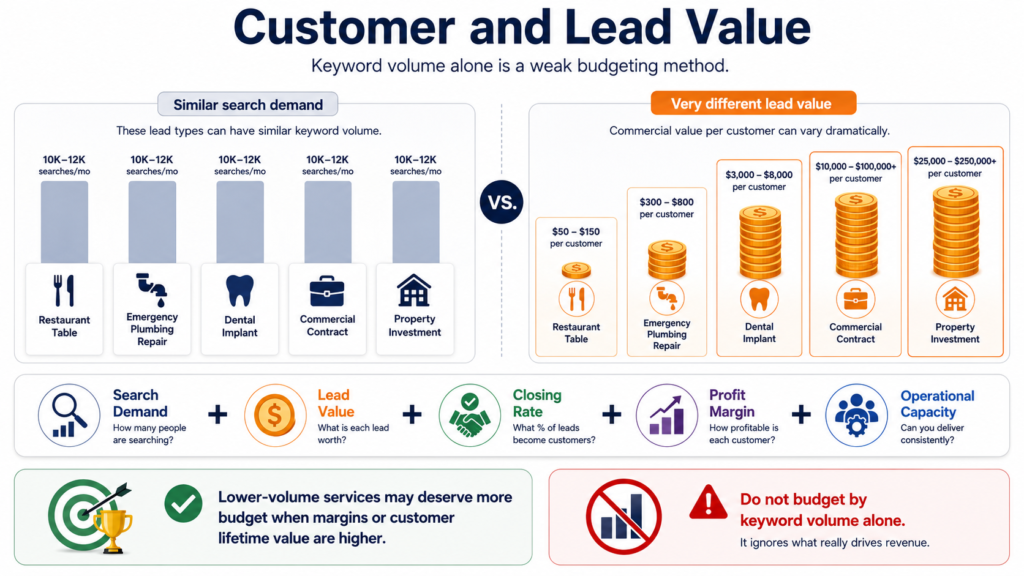
Two businesses may target similar search volumes but have very different commercial opportunities.
A qualified enquiry for a restaurant table, emergency plumbing repair, dental implant, commercial contract, or property investment does not carry the same potential value.
Keyword volume alone is therefore a weak budgeting method.
A useful campaign prioritizes the combination of:
Search demand + Lead value + Closing rate + Profit margin + Operational capacity
A lower-volume service may deserve more investment when it generates stronger margins or higher customer lifetime value.
4. Website Condition
A technically healthy website allows the campaign to invest in growth sooner.
A weak website may first require:
- Indexation repairs
- Website architecture changes
- Redirect corrections
- Duplicate-page consolidation
- Internal-link improvements
- Mobile performance work
- Structured data
- Canonical corrections
- Sitemap cleanup
- Conversion-path improvements
Google’s minimum technical requirements include allowing Googlebot to access the page, returning a successful HTTP status, and providing indexable content. Meeting those requirements does not guarantee indexing or rankings, but failing them can prevent useful pages from performing.
Two businesses targeting the same service and city can therefore require very different budgets. One may need refinement. The other may need structural repair before growth work begins.
5. Google Business Profile Condition
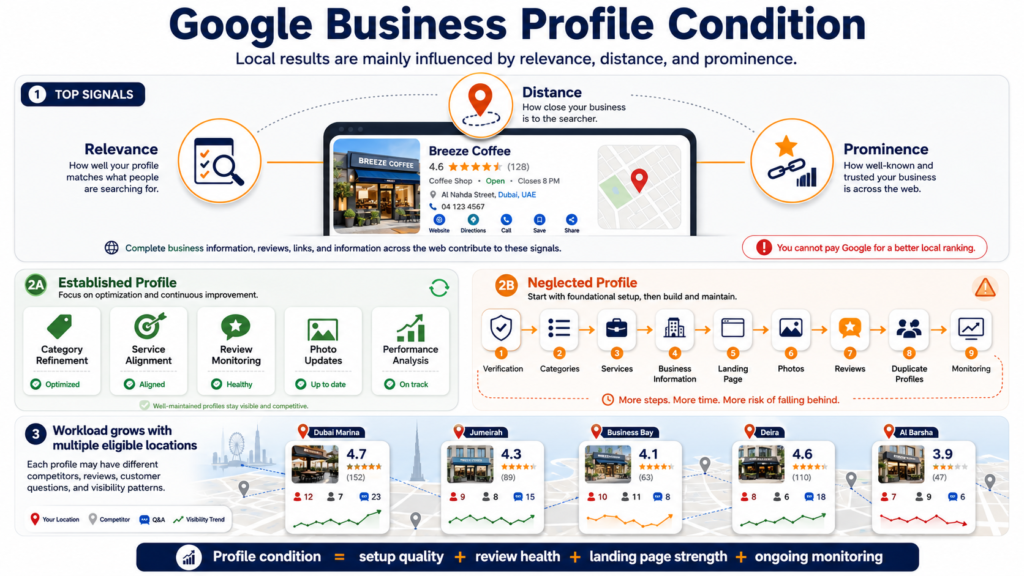
Google states that local results are mainly influenced by relevance, distance, and prominence. Complete business information, reviews, links, and information available across the web can contribute to these signals. Businesses cannot pay Google for a better local ranking.
An established profile may need category refinement, service alignment, review monitoring, photo updates, and ongoing performance analysis. According to Google’s local ranking factors, local results are mainly influenced by relevance, distance, and prominence.
This is the strongest external source for your Google Business Profile section because Google directly explains profile completeness, verification, reviews, photos, relevance, distance, prominence, and why businesses cannot pay for better local rankings.
This is the strongest external source for your Google Business Profile section because Google directly explains profile completeness, verification, reviews, photos, relevance, distance, prominence, and why businesses cannot pay for better local rankings.
A neglected profile may require work across the entire profile ecosystem:
Verification → Categories → Services → Business information → Landing page → Photos → Reviews → Duplicate profiles → Monitoring
The workload grows when a business operates several eligible locations. Every profile may have different competitors, reviews, customer questions, and visibility patterns.
6. Content Gap
A business with established service and location coverage may need selective optimization.
A business with major content gaps may require:
- Core service pages
- Subservice pages
- City or emirate pages
- Branch pages
- Supporting guides
- Pricing content
- Comparison pages
- Frequently asked questions
- Internal links
- Case studies and local proof
The important distinction is not page quantity. It is information value.
Ten pages created by replacing one location name with another do not provide the same value as ten pages built from separate market, service, competitor, and customer research.
A useful content process follows this sequence:
Demand research → Search-intent mapping → Page selection → Content production → Internal linking → Publishing → Indexation review → Performance measurement
The cost comes from the quality of this process, not the number of documents delivered.
7. Authority and Reputation Gap
Reviews, citations, backlinks, partnerships, and brand mentions support different parts of local visibility.
- Reviews provide customer evidence and strengthen reputation.
- Citations help maintain consistent business information across relevant platforms.
- Backlinks transfer external authority and referral value.
- Local mentions connect the business with its geographic market.
- Industry associations provide contextual credibility.
A business does not automatically need a fixed number of links every month.
It needs the type of credibility that stronger competitors possess and the business currently lacks.
A proposal promising “20 backlinks per month” without defining source relevance, editorial standards, traffic quality, or placement method turns authority building into a commodity. The number is easy to report but may have little connection to local visibility.
8. Implementation Responsibility
An SEO recommendation has no commercial value until somebody implements it correctly.
A consulting engagement may cost less when the company has developers, writers, designers, and marketing staff who can execute recommendations internally.
A managed campaign costs more when the agency must:
Research → Create → Implement → Test → Verify → Report
The proposal needs to clarify four responsibilities:
- Who identifies the work?
- Who approves it?
- Who implements it?
- Who verifies it?
Unclear ownership is one of the main reasons SEO campaigns remain active without producing meaningful changes.
9. Measurement Complexity
Tracking one website form is easier than measuring calls, WhatsApp enquiries, bookings, direction requests, branch-level leads, qualified opportunities, and sales.
Advanced measurement may require:
- Google Analytics 4
- Google Search Console
- Google Business Profile optimization
- Call-tracking software
- Form-event tracking
- WhatsApp click tracking
- CRM integration
- Lead-source attribution
- Branch-level dashboards
- Lead-quality feedback
The cost increases when reporting must connect several search assets to individual services, locations, and commercial outcomes.
9 Local SEO Pricing Factors in the UAE
Local SEO pricing in the UAE depends on the number of locations, the competitiveness of the target market, the condition of the business’s online presence and the amount of work required to generate qualified local enquiries. A single-location company targeting one service area generally requires a smaller campaign than a multi-location business competing across Dubai, Abu Dhabi and other Emirates. The following nine factors have the greatest influence on local SEO costs.
1. Number of Business Locations
The number of physical branches or verified service locations directly affects campaign scope. A business with one office usually requires one Google Business Profile strategy, one primary location page and a focused set of local citations. A company with several branches requires separate profile optimization, location-specific content, review management, citation consistency and ranking tracking for each location. Pricing increases when every branch targets different services, districts or customer groups because each location must develop its own local relevance and authority.
2. Target Cities, Districts and Service Areas
Local SEO costs depend on the geographic area the business wants to cover. Targeting one district, such as Business Bay, may require fewer assets than targeting Dubai, Abu Dhabi, Sharjah and the wider UAE. Competitive locations may also require dedicated service-area pages, district content, local links and separate rank tracking. The campaign becomes more expensive when a business wants visibility across many suburbs or districts because each target area needs sufficient relevance without creating thin or duplicated location pages.
3. Industry and Local Competition
Some industries are more competitive than others in UAE search results. Legal services, healthcare, real estate, home services, automotive, hospitality and business consultancy often contain established competitors with strong websites, active Google Business Profiles, large review portfolios and high-authority backlinks. Entering these markets requires deeper competitor analysis, stronger content, more local proof and sustained authority development. A less competitive niche may improve visibility with foundational optimization, while a crowded industry usually requires a larger monthly investment.
4. Google Business Profile Condition
The current condition of the Google Business Profile affects how much work is required. A complete and verified profile with accurate categories, services, opening hours, photos and reviews needs less corrective work than a suspended, duplicated or poorly optimized listing. The campaign may also need to resolve incorrect map pins, ownership conflicts, inconsistent business details, duplicate profiles or inappropriate categories. Profile recovery and compliance work can increase the price because it involves investigation, documentation and communication with Google rather than routine optimization alone.
5. Website Technical Health and Local Architecture
Local SEO performance depends on the website’s technical condition and page structure. Broken links, slow mobile performance, duplicate pages, incorrect canonicals, crawl problems and weak internal linking can prevent important service and location pages from ranking. The website may also lack a clear hierarchy connecting services, locations, industries and contact pages. Pricing increases when the campaign must include technical auditing, template corrections, schema implementation, page consolidation or website restructuring before local content can perform effectively.
6. Number of Services and Keywords
A business targeting one core service requires a narrower campaign than a company offering several service categories. For example, a cleaning company targeting only office cleaning has a smaller keyword scope than one targeting office cleaning, warehouse cleaning, retail cleaning, school cleaning and medical-facility cleaning across several locations. Each priority service may require its own page, keyword mapping, internal links, supporting content and conversion elements. The larger the service and keyword portfolio, the more research, writing, optimization and tracking the campaign requires.
7. Local Content and Location-Page Requirements
The amount and quality of content required influence local SEO pricing. Some businesses already have useful service pages, location pages, case studies and FAQs that can be improved. Others need new pages built from the beginning. Effective location content must explain the service, target customer, coverage area, local proof, delivery process and conversion path without repeating the same text across different locations. Costs increase when the campaign requires multiple service-location combinations, bilingual content, industry pages, local guides or ongoing content production.
8. Reviews, Citations and Local Authority
Businesses with few reviews, inconsistent directory listings or limited local authority usually require more off-page work. The campaign may include citation auditing, business-detail corrections, directory submissions, review-acquisition systems, local partnerships and relevant UAE backlinks. A company with strong reviews and consistent business information may need only maintenance and monitoring. Pricing rises when inaccurate listings are widespread or when competitors have substantially stronger review profiles and local authority.
9. Language, Reporting and Implementation Support
UAE local SEO campaigns may target English, Arabic or both languages. Bilingual campaigns require separate keyword research, content optimization, local terminology, metadata, internal linking and quality review for each language. Pricing also depends on the level of reporting and implementation support included. A basic campaign may provide recommendations and monthly ranking reports, while a comprehensive service may include website changes, Google Business Profile management, call tracking, lead reporting, content publishing, developer coordination and post-implementation validation. The more execution and accountability included, the higher the local SEO investment.
What Should a Monthly Local SEO Budget Include?
A monthly retainer does not buy a ranking position.
It funds the research, assets, implementation, and measurement required to improve the business’s ability to compete.
A complete campaign may include six connected workstreams.
1. Commercial Research and Prioritization
Research determines where the campaign can create the greatest business value.
The provider may analyze:
- Search demand
- Priority services
- Target locations
- Profit margins
- Lead quality
- Competitor strength
- Current visibility
- Seasonal demand
- Operational capacity
The output should be a commercial opportunity map:
Search demand + Service value + Geographic opportunity + Competitive distance + Business capacity
This prevents the campaign from investing equal resources in services that produce unequal value.
2. Google Business Profile Management
Google Business Profile management involves more than publishing occasional posts.
The work may include:
- Primary and secondary category selection
- Service configuration
- Opening-hour updates
- Business-description refinement
- Website and landing-page alignment
- Photo and video planning
- Review monitoring
- Duplicate-profile management
- Profile performance analysis
- Question and answer monitoring
The profile must also connect with the website.
A profile targeting a specific service while linking to an unrelated homepage creates a weak relationship between the search, business entity, destination page, and conversion action.
The ideal connection is:
Search intent → Business Profile → Relevant landing page → Clear conversion action
3. Website and Technical Optimization
Technical SEO helps important service and location pages become discoverable, crawlable, indexable, and understandable.
The work may include:
- Indexation reviews
- Internal linking
- Redirects
- Canonical tags
- Sitemap control
- Mobile performance
- Structured data
- Duplicate-content consolidation
- Page-template improvements
- Broken-link repairs
- Core conversion checks
The priority should depend on business impact.
A minor metadata inconsistency does not deserve the same attention as an indexation issue affecting every service or location page.
A strong campaign separates critical constraints from low-impact cleanup tasks.
4. Service, Location and Supporting Content
Content connects the business’s real services with the language customers use when searching.
Different pages have different roles:
- A service page explains the commercial service.
- A location page establishes relevance within a target market.
- A branch page represents a real physical location.
- A pricing page helps users evaluate affordability and scope.
- A comparison page supports users considering different solutions.
- A guide answers questions before the user is ready to enquire.
- A case study provides evidence of process and outcomes.
These pages must not compete for the same search intent.
Clear page roles reduce keyword cannibalization and create stronger relationships across the website.
5. Reviews, Citations and Authority Development
Reviews, citations, and links are often grouped under off-page SEO but they solve different problems.
A useful campaign diagnoses which area is weak instead of delivering the same off-page package to every client.
For example:
- A new clinic may need a reliable review-acquisition process.
- A relocated business may need citation cleanup.
- A strong local brand may need industry links and editorial mentions.
- A multi-branch company may need consistent information across every location.
The proposal should define which problem the off-page work is designed to solve.
6. Conversion Tracking and Reporting
Reporting must explain:
- What changed
- Why it changed
- What impact it produced
- What the campaign will prioritize next
Activity reports list completed tasks.
Performance reports connect those tasks with visibility, interactions, enquiries, qualified leads, and revenue.
A useful reporting chain is:
Implementation → Search visibility → User interaction → Enquiry → Qualified lead → Customer
Where data is available, reporting should separate:
- Branded and non-branded searches
- Organic and local-pack visibility
- Service performance
- Location performance
- Calls
- Forms
- WhatsApp enquiries
- Bookings
- Qualified and unqualified leads
Single-Location vs. Multi-Location Local SEO Pricing
Single-location and multi-location SEO are not the same campaign at different sizes.
They require different operating systems.
Single-Location Local SEO
A focused single-location campaign normally connects:
Business → Main Google Business Profile → Core service pages → Local signals → Reviews → Lead tracking
The campaign may concentrate on one market, one review system, and one set of local competitors.
However, one location does not automatically mean a low price.
A clinic, law firm, property company, or specialist contractor competing for high-value enquiries may require extensive technical, content, conversion, and authority work despite operating from one office.
Multi-Location Local SEO
Multi-location SEO must balance central brand control with individual branch relevance.
The campaign may require:
- Scalable website architecture
- Unique branch pages
- Separate Google Business Profiles
- Duplicate-content controls
- Location-specific photos and proof
- Review workflows for each branch
- Consistent business information
- Geographic internal linking
- Branch-level performance reporting
- Central approval and quality standards
Each branch must support the main brand while remaining useful to customers in its local market.
The additional cost comes from multiplication and coordination.
One change may need to be planned centrally, adapted locally, implemented across several assets, and verified separately for every branch.
How Should an Agency Calculate a Local SEO Quote?
A serious quote begins with diagnosis rather than a prebuilt package.
The calculation can be structured around five questions.
What Is the Business’s Current Visibility?
The provider should review:
- Organic rankings
- Local-pack visibility
- Profile performance
- Indexed pages
- Branded searches
- Non-branded searches
- Current traffic
- Calls and forms
- Existing lead quality
This establishes the starting position.
Where Is the Commercial Opportunity?
The provider should identify which services and locations offer sufficient demand, commercial value, and operational capacity.
Ranking for a service the company cannot deliver profitably does not create useful growth.
How Far Ahead Are the Competitors?
Competitive distance may exist across:
- Website quality
- Service-page depth
- Technical performance
- Reviews
- Profile completeness
- Citations
- Backlinks
- Local mentions
- Conversion experience
The larger the distance, the more resources may be required to close it.
What Must Be Created, Repaired, Managed and Measured?
A transparent scope separates four types of work.
| Work Type | Example |
| Create | Service pages, location pages, content briefs, tracking systems and dashboards |
| Repair | Indexation issues, weak architecture, duplicate pages and inconsistent business information |
| Manage | Profiles, reviews, citations, content publishing and authority development |
| Measure | Rankings, calls, forms, qualified leads, sales and revenue |
This distinction makes the workload visible.
It also prevents one-time setup tasks from being presented as permanent monthly deliverables.
What Can the Internal Team Implement?
The agency needs to know:
- Who approves content?
- Who updates the website?
- Is development support available?
- Who requests and responds to reviews?
- Can the team provide lead-quality data?
- How long do approvals normally take?
A campaign with delayed approvals and no implementation access may require more coordination while producing slower progress.
What Is Commonly Excluded From Local SEO Packages?
The phrase “local SEO” does not guarantee that every related service is included.
Depending on the provider, the following may require separate approval or pricing:
- Website development
- Major technical repairs
- Copywriting beyond a monthly allowance
- Arabic SEO
- Translation and localization
- Paid directory fees
- Digital PR placement costs
- Call-tracking software
- CRM configuration
- Professional photography
- Review-response management
- Profile reinstatement
- Suspension appeals
- Work for additional branches
- Landing-page design
- Conversion-rate optimization
These exclusions are not automatically unreasonable.
The problem is ambiguity.
A proposal becomes difficult to evaluate when it promises an outcome but excludes the implementation required to pursue that outcome.
How Can You Tell Whether Local SEO Is Too Cheap?
Cheap local SEO is not automatically poor SEO.
A business with one location, limited competition, a healthy website, and an established profile may only need a narrow campaign.
The concern begins when the available budget cannot realistically support the diagnosed workload.
Common warning signs include:
- Guaranteed Google rankings
- Vague monthly deliverables
- Hundreds of directory submissions
- Fixed backlink quotas
- No technical review
- No competitor analysis
- No implementation responsibility
- Reused location content
- Reports focused only on completed tasks
- No call or form tracking
- No plan for qualified-lead measurement
- The same package for every industry
The correct comparison is:
Required work → Included scope → Implementation depth → Measurement quality → Price
A narrow campaign can legitimately cost less.
A complex campaign cannot be delivered through the same resource model without reducing quality, depth, or implementation somewhere.
When Is a Higher Local SEO Budget Justified?
A higher budget may be justified when the business faces greater complexity or a larger commercial opportunity.
This commonly occurs when:
- One qualified lead has substantial value
- Competitors have stronger websites and authority
- Several branches require active management
- The website needs structural repairs
- Important service pages are missing
- The business targets several emirates
- Arabic and English visibility are commercially important
- Advanced lead attribution is required
- The business needs regular development and content implementation
- Reputation problems require active management
The argument is not simply “spend more to get better SEO.”
The stronger logic is:
Greater opportunity or complexity → More diagnosis → More assets → More implementation → More verification → Greater resource requirement
A higher fee without additional strategic depth, implementation, or measurement is not justified.
How Should Local SEO ROI Be Calculated?
Local SEO ROI must connect visibility with commercial outcomes.
Rankings and traffic are useful diagnostic indicators, but they do not show whether the campaign produced profitable customers.
A complete measurement model contains four levels.
Search Visibility
Measure:
- Search impressions
- Organic clicks
- Click-through rate
- Average positions
- Non-branded searches
- Priority service-page visibility
- On-page SEO
- Local-pack coverage
Local Interaction
Measure:
- Website visits from the profile
- Phone calls
- Direction requests
- Booking clicks
- WhatsApp clicks
- Geographic visibility around each eligible location
Lead Performance
Measure:
- Forms
- Calls
- Quote requests
- Appointments
- Bookings
- WhatsApp enquiries
- Qualified leads
- Unqualified leads
Raw lead volume can be misleading.
Twenty irrelevant enquiries may create less value than five enquiries from customers who match the company’s service area, budget, and service requirements.
Commercial Performance
Where reliable data is available, measure:
- Lead-to-sale rate
- Customer acquisition cost
- Revenue
- Gross profit
- Opportunity value
- Cost per qualified lead
- Repeat-purchase value
- Customer lifetime value
The complete chain is:
Visibility → Interaction → Enquiry → Qualified lead → Sale → Revenue
A Practical Local SEO Break-Even Calculation
A simple planning formula is:
Break-even customers = Monthly SEO fee ÷ Gross profit per new customer
Consider an illustrative example.
A company invests AED 5,000 per month and earns AED 2,500 in gross profit from an average new customer.
AED 5,000 ÷ AED 2,500 = Two new customers required to break even
When the business closes 25% of qualified enquiries, it needs approximately eight qualified leads to acquire two customers.
This formula does not predict SEO performance.
It shows the commercial threshold the campaign must eventually cross.
Longer-term value may be higher when customers renew contracts, make repeat purchases, purchase additional services, or refer other customers.
Example Local SEO Budgets
The following examples are illustrations, not fixed quotes.
Single Clinic in One Dubai Community
A clinic with one profile, a healthy website, several treatment pages, and moderate competition may require:
- Profile refinement
- Treatment keyword mapping
- On-page optimization
- Review procedures
- Local citations
- Call and booking tracking
Illustrative budget: AED 2,500–5,000 per month
The range may increase when medical content, technical repairs, or competitive authority development is required.
Home-Service Company Covering Dubai and Sharjah
A contractor targeting several services across two markets may require:
- Service-page expansion
- Dubai and Sharjah landing pages
- Google Business Profile alignment
- Technical improvements
- Review generation
- Local links
- Call tracking
Illustrative budget: AED 4,000–8,000 per month
The actual price depends on service competition, valid service coverage, website condition, and implementation responsibility.
Multi-Branch Business Across the UAE
A clinic group, retailer, education provider, or service brand with several branches may require:
- Branch architecture
- Unique location pages
- Separate profiles
- Review workflows
- Citation consistency
- Location-specific content
- Central quality control
- Branch-level reporting
- Arabic and English support
Illustrative budget: AED 8,000–15,000+ per month
The main cost is not simply the number of branches. It is the coordination required to maintain accuracy, relevance, implementation quality, and measurement across all locations.
Which Local SEO Pricing Model Is Right?
The correct pricing model depends on whether the work is ongoing, temporary, advisory, or distributed across several locations.
Monthly Retainer
A monthly retainer suits businesses that need ongoing:
- Technical monitoring
- Profile management
- Content development
- Review support
- Authority development
- Reporting
- Strategic adjustment
The value comes from continuous prioritization, not repeating the same task list every month.
Project-Based Engagement
A project fee suits work with a defined beginning and end, such as:
- Technical SEO audit
- Website migration
- Tracking setup
- Location architecture
- Google Business Profile setup
- Citation cleanup
- Content audit
The proposal should define the deliverables, implementation responsibility, timeline, and completion criteria.
Consulting Model
Consulting suits organizations with internal staff capable of implementing recommendations.
The relationship is:
Consultant diagnoses and advises → Internal team implements → Consultant verifies
This may reduce agency production costs, but it requires reliable internal capacity.
Multi-Location Program
A multi-location program suits:
- Franchises
- Clinics
- Retailers
- Education providers
- Office networks
- Hospitality groups
- Service companies
It normally combines central governance with branch-level profile management, local content, reviews, citations, implementation, and reporting.
The decision sequence should be:
Business model → SEO constraint → Execution requirement → Internal capability → Pricing model
Final Decision: How Much Should You Budget?
Do not begin with the cheapest package or the largest deliverables list.
Begin with three questions:
- Which services and locations can generate the most commercial value?
- What prevents the business from competing for those searches today?
- What level of research, creation, implementation, and measurement is required to close that gap?
A focused single-location business may begin around AED 1,500 to AED 3,000 per month.
A growing local business targeting competitive services may require AED 3,000 to AED 7,000 per month.
A multi-location, multilingual, or highly competitive campaign may require AED 7,000 to AED 15,000 or more.
The right budget is not the lowest amount an agency is willing to accept.
It is the amount required to address the business’s actual visibility constraints without paying for irrelevant work.
FAQS
How much does local SEO cost in the UAE?
Focused local SEO campaigns may begin around AED 1,500 per month. Growth campaigns often fall between AED 3,000 and AED 7,000, while competitive, multilingual, or multi-location programs may require AED 7,000 to AED 15,000 or more. The final price depends on competition, website condition, location coverage, content, profiles, authority, and implementation.
How much does local SEO cost per month in Dubai?
A single-location business targeting a narrow service area may invest between AED 1,500 and AED 3,500 per month. Businesses targeting several competitive services across Dubai may require AED 4,000 to AED 10,000 or more. These are planning ranges rather than fixed market rates.
Why do local SEO prices vary between agencies?
Agencies include different levels of research, technical implementation, content creation, Google Business Profile management, citations, reviews, authority development, and reporting. Buyers need to compare scope, quality, and implementation responsibility before comparing fees.
Is Google Business Profile optimization included?
Sometimes. The proposal should clarify whether it includes a one-time setup or ongoing management covering categories, services, information, photos, reviews, profile monitoring, and landing-page alignment.
Does multi-location SEO cost more?
Usually. Multiple locations create additional profiles, pages, competitors, reviews, citations, local signals, approval requirements, and reporting needs. The final cost depends on which activities can be managed centrally and which require branch-level work.
Is local SEO a one-time service?
Some setup work can be completed as a project. Competitive local visibility usually requires ongoing monitoring because competitors, search behavior, website content, business information, and customer reviews continue to change.
How long does local SEO take?
There is no universal timeline. Progress depends on competition, website condition, content gaps, authority, number of locations, and implementation speed. The campaign should demonstrate measurable strategic progress rather than repeat an unchanged task list.
Are backlinks included in local SEO pricing?
They may be included, but the proposal should explain the type of authority work being performed. A fixed link quantity without relevance, editorial quality, source standards, or commercial purpose is not a useful measure of value.
Should a business choose the cheapest local SEO package?
Only when the package covers the work the business genuinely requires. A low price is not a saving when technical issues, content gaps, profile management, or implementation remain outside the scope
How should local SEO ROI be measured?
ROI should follow this chain:
Search visibility → Local interaction → Enquiry → Qualified lead → Customer → Revenue
Rankings and traffic are supporting indicators. The strongest evaluation focuses on qualified opportunities, sales, gross profit, and customer acquisition cost.