
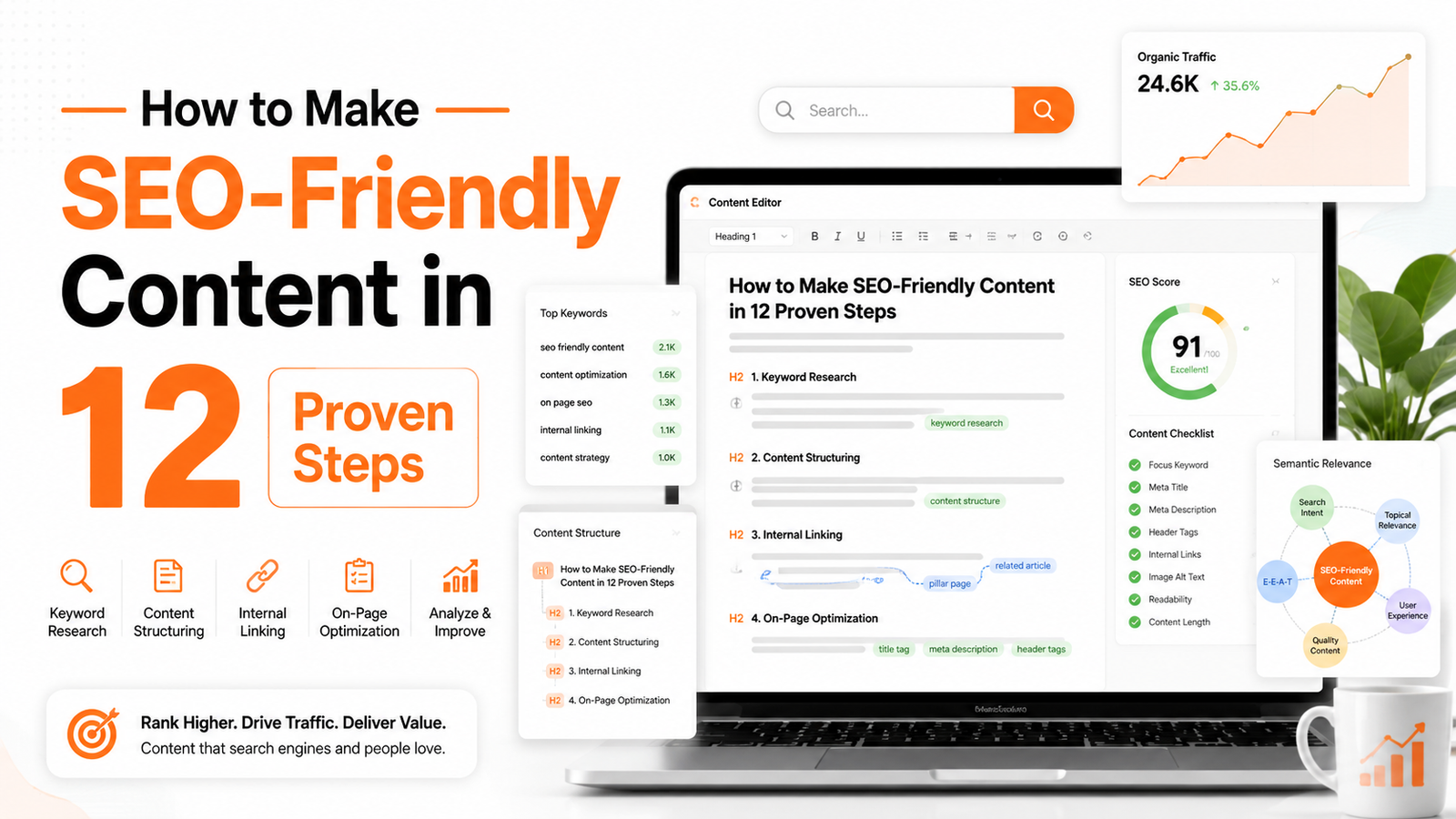
SEO-friendly content answers the searcher’s real question, adds useful information, uses clear semantic structure, and remains easy for search engines to crawl and understand. Start with search intent, not keyword repetition, then optimize the finished answer.
That sounds simple. The execution is where most pages fail.
A page can contain the right keyword and still miss the query. It can be 3,000 words and add almost nothing. It can read well and remain practically invisible because important pages are not linked, images lack context, or the URL cannot be indexed.
Google’s current guidance is more useful than the old formula of “keyword + word count + backlinks.” Search Essentials says creators should produce helpful, reliable, people-first content, use terminology searchers actually use in prominent places, and make links crawlable.
So the working model is:
Search need → query → intent → topic → evidence → answer → structure → optimization → accessibility → measurement.
The 12 steps below follow that sequence.
What Is SEO-Friendly Content?
SEO-friendly content is web content created to satisfy a defined user need while remaining relevant, useful, trustworthy, understandable, crawlable, and indexable for search engines.
SEO is the broader discipline. Content SEO is one branch of it. SEO-friendly content, search-optimized content, SEO writing, and optimized web content are closely related terms within that branch.
The opposite is search-first commodity content: pages created mainly to occupy a keyword position while adding little beyond what already exists.
Google makes this distinction explicitly. Its people-first guidance asks publishers to consider whether an existing or intended audience would find the content useful and whether the page demonstrates first-hand expertise and substantial value.
This means optimization should improve the connection between a searcher, query, document, and answer. It should not make the writing sound as if a keyword-placement tool wrote it.
Does E-E-A-T directly determine rankings?
No. E-E-A-T is not described by Google as a single ranking factor. It is a useful quality-evaluation framework centered on Experience, Expertise, Authoritativeness, and Trust.
Google explains that its Search Quality Rater Guidelines help raters evaluate whether ranking systems are producing useful results; the ratings themselves do not directly control individual rankings. Trust is especially important within the E-E-A-T framework.
For a content writer, the practical implication is straightforward: identify the author when authorship matters, demonstrate relevant experience, support factual claims, correct errors, and make it easy for a reader to understand where important information came from.
What Does Google Want From SEO Content in 2026?
Google wants pages that help people complete their search task, not pages manufactured primarily to imitate ranking signals.
One terminology update matters here. The old “Helpful Content Update” language can create the wrong mental model. Google incorporated its helpful-content system into its core ranking systems in March 2024. Helpfulness is therefore better treated as an ongoing content-quality principle rather than a separate update you optimize for once.
Google’s generative AI guidance preserves the same foundation. SEO best practices still matter for AI features, while unique, non-commodity, expert-led information receives explicit emphasis.
That changes the question from:
“How many times should I use the keyword?”
to:
“What information does this query require, what evidence supports it, and what useful information can this page contribute?”
That is a better starting point for both traditional search and AI-assisted search experiences.
1. Define the Audience Before You Choose the Content Angle
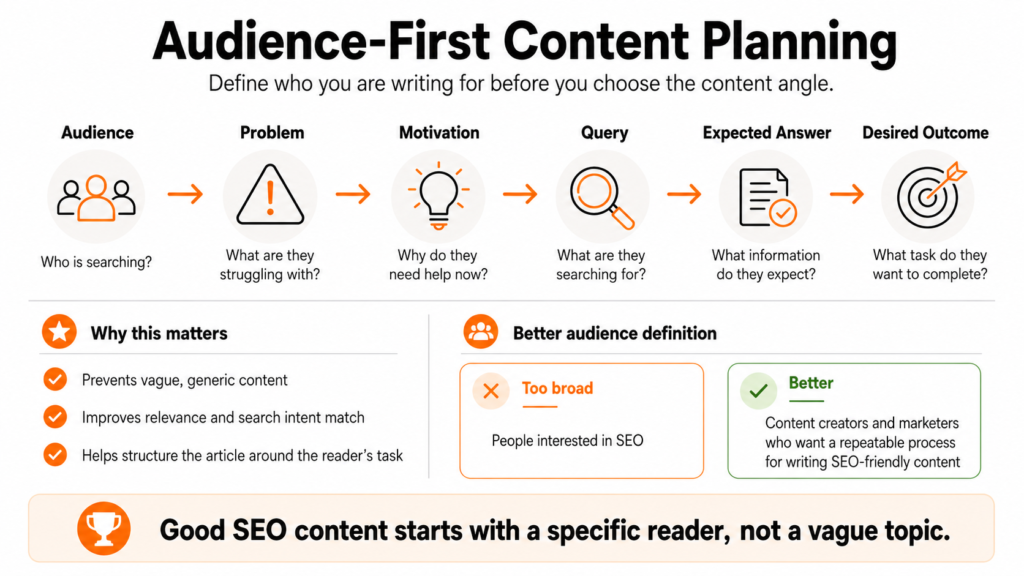
Who are you actually writing for?
Define the specific searcher, their problem, their existing knowledge, and the task they want to complete before you draft the page.
“People interested in SEO” is not a useful audience definition.
A content writer asking how to create an SEO article has different prior knowledge from a small-business owner wondering why a blog gets no traffic. An SEO executive may already understand title tags and keywords but need a repeatable editorial workflow.
The relevant semantic sequence is:
Audience → problem → motivation → query → expected answer → desired outcome.
For this article, the reader already creates or manages content but lacks confidence that the content is correctly optimized. That distinction affects vocabulary, examples, explanation depth, and the amount of technical detail required.
Audience definition also prevents unnecessary sections. A reader searching for a practical SEO-writing process does not need 600 words explaining what a search engine is.
They need the process.
What should you record about the audience?
Focus on attributes that change the answer: role, SEO knowledge, search problem, decision stage, expected format, and desired result.
For example, a beginner may need search intent defined before SERP analysis. An experienced content marketer probably needs stronger treatment of content gaps, entity relationships, internal linking, and performance measurement.
The page can serve both, but the main reader should remain clear from the first paragraph to the final CTA.
2. Identify Search Intent Before Writing
What is search intent?
Search intent is the task or outcome a user is trying to achieve when they enter a query.
It is the connection between the words typed into a search engine and the job the searcher actually wants completed.
The broad hypernym is search intent. Its common hyponyms include informational intent, commercial investigation, transactional intent, navigational intent, and local intent.
Those labels matter less than the underlying job.
A searcher entering “how to make SEO-friendly content” wants instructions. A person searching “best SEO content optimization tools” wants evaluation. A searcher entering “SEO content writing services” is much closer to a vendor decision.
The mistake is assuming that because all three queries contain “SEO content,” one page should target all three equally.
It should not.
How do you determine search intent?
Inspect the query language and the current search results, then identify the dominant task, content type, format, and angle.
For a how-to query, examine whether Google predominantly returns tutorials, guides, videos, tools, product pages, forums, or mixed formats.
Do not copy the ranking pages mechanically. Use them as evidence of what searchers are being served.
Then ask a more useful question:
What does the searcher still need after reading those pages?
That is where information gain starts.
3. Find Keywords With Intent, Demand, and Realistic Ranking Potential
How do you choose a keyword for SEO content?
Choose a query that is relevant to the business and audience, has demonstrable search demand, matches the page’s purpose, and has a competitive environment you can realistically enter.
A keyword is the parent concept. Primary keywords, secondary keywords, question keywords, branded terms, non-branded terms, and long-tail queries are narrower types.
But a keyword list is not a content strategy.
A useful decision model is:
Keyword Opportunity = Relevance × Intent Fit × Demand × Ranking Feasibility × Business Value
The multiplication matters conceptually. If one variable is close to zero, a large search-volume number does not rescue the opportunity.
A keyword with 10,000 monthly searches but weak business relevance may generate attention with little commercial value. A smaller query that closely matches a service, product, or decision can produce less traffic but better outcomes.
Should you choose keywords only by search volume?
No. Search volume measures estimated demand, not whether a query is relevant, winnable, or commercially useful.
Assess the complete query environment.
Search demand tells you whether interest exists. Ranking difficulty estimates competitive resistance. Search intent tells you what the user expects. Business value tells you whether satisfying that demand matters to the organization.
Then study query variations.
For “SEO-friendly content,” related language may naturally include SEO writing, content optimization, search intent, keyword research, content structure, semantic SEO, internal links, title tags, meta descriptions, alt text, crawlability, indexing, E-E-A-T, and organic traffic.
Use those concepts when they help explain the subject. Do not insert them to satisfy an arbitrary NLP score.
4. Study the SERP and Find Information Gaps
What should you analyze in competing pages?
Analyze what ranking pages repeatedly cover, what search task they satisfy, what evidence they use, and what useful information they fail to provide.
SERP analysis is comparative research, not a rewriting exercise.
Start with the common denominator. If nearly every ranking page discusses search intent, keyword research, titles, headings, links, and images, those concepts probably form part of the expected topic model.
Then look beyond the common denominator.
If ten results all say “write for humans,” repeating the sentence creates no meaningful information gain.
Ask what the phrase actually requires in practice.
Can you show how intent changes an outline? Can you explain how to reject a keyword despite attractive search volume? Can you demonstrate how an unsupported claim becomes a sourced proposition? Can you show how two similar articles should be separated by intent rather than merged?
Those additions make the document more useful.
Google’s current AI-search guidance explicitly encourages content that contributes value beyond common knowledge instead of producing another commodity version of information already available.
Use a content-gap model, not a competitor-copy model
A useful semantic progression is:
Existing results → repeated information → unanswered questions → weak evidence → outdated facts → missing examples → new contribution.
That final element is the point.
You are not trying to become the average of page one.
You are trying to satisfy the same search need with a more complete and defensible answer.
5. Build a Topic-First Content Outline
How should an SEO article be structured?
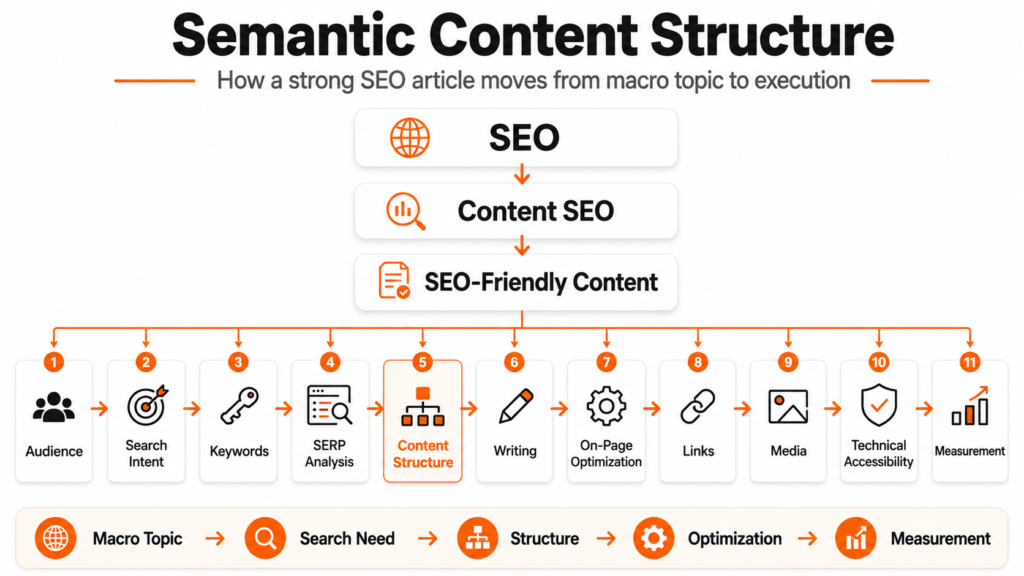
Structure the page around the meaning of the topic and the sequence of the user’s task, then map relevant keywords and entities into that structure.
Do not build an outline by collecting every keyword that contains the same phrase.
Start with the macro context.
For this article, the macro context is creating SEO-friendly content.
The hierarchy beneath it should move from broader entities to narrower attributes:
SEO → Content SEO → SEO-Friendly Content → Audience → Search Intent → Keywords → SERP Analysis → Content Structure → Writing → On-Page Optimization → Links → Media → Technical Accessibility → Measurement.
That is a semantic hierarchy.
Each major heading answers one necessary question about the parent topic. Each subheading resolves a narrower attribute or process.
This creates a stable context vector from the H1 to the conclusion.
What is a good heading sequence?
A reader should be able to scan only the headings and still understand the process.
Harvard’s Digital Accessibility guidance recommends using semantic structure, headings, lists, and tables to support scanning and comprehension. Yale similarly recommends descriptive headings, short paragraphs, and front-loaded information for web readers.
That is not merely visual formatting. It is information architecture.
A heading should tell the user what information comes next.
“Keyword Research” is acceptable.
“How Do You Choose a Keyword With Ranking Potential?” is usually more informative because it expresses the actual question being resolved.
6. Write a Clear Title and H1
What makes an SEO title effective?
A strong SEO title identifies the page topic, aligns with search intent, sets an accurate expectation, and uses the searcher’s language naturally.
Google recommends descriptive, concise title text and warns against vague, repetitive, boilerplate, or keyword-stuffed titles. Google may also generate a displayed title link from several page signals rather than using the HTML title exactly as written.
For this article:
How to Make SEO-Friendly Content in 12 Proven Steps
works because the title contains four useful attributes:
Task: make
Entity: SEO-friendly content
Format: procedural guide
Scope: 12 steps
There is no need to force extra phrases such as “SEO writing,” “content optimization,” “Google rankings,” and “semantic SEO” into the same title.
Instead, treat the title and H1 as part of broader on-page optimization, where headings, metadata, content structure, internal links, and page relevance work together to support the target search intent.
Those are subordinate concepts. They belong in the document, not all in the title.
Should the title and H1 be identical?
They can be, but they do not have to be.
The important requirement is semantic consistency. If the title promises a 12-step SEO-content guide while the H1 suddenly changes the page into “Ultimate Digital Marketing Strategies,” the document has introduced a new macro context.
Keep the page promise stable.
7. Answer the Main Question Immediately
Should an SEO article start with a long introduction?
No. Answer the primary question first, then explain the answer with evidence, conditions, examples, and implementation details.
Readers should not have to excavate the page.
A useful answer pattern is:
Question → definitive answer → evidence → qualification → example → next question.
That sequence works especially well for informational queries because every section can stand as a useful answer while still contributing to the wider document.
It also prevents a common content failure: introducing peripheral concepts before resolving the user’s immediate need.
If someone asks where a primary keyword should appear, start by identifying useful locations such as the title, main heading, introductory context, relevant subheadings, body copy, anchor text, image context, and metadata where appropriate.
Then explain the conditions.
Do not begin with the history of keyword optimization.
Does every section need a fixed word count?
No. Section length should reflect information demand, not a uniform template.
A definition may need 40 words. A process may require 300. A comparison may need a table.
Google’s guidance focuses on usefulness and satisfaction rather than prescribing a preferred article length.
Write until the question is sufficiently resolved.
Then stop.
8. Add Original Evidence, Experience, and Expert Support
How do you make SEO content non-commodity?
Add information that a writer cannot obtain by merely paraphrasing the same ranking pages.
This is where E-E-A-T becomes practical.
Experience can be demonstrated through implementation notes, screenshots, tested workflows, observed limitations, before-and-after examples, or real project outcomes.
Expertise can appear through accurate technical explanation and qualified review.
Authority can develop through reputation, citations, references, and consistent subject coverage.
Trust is strengthened by source transparency, accurate claims, visible authorship where appropriate, correction processes, and clear distinctions between evidence and inference.
Stanford’s Web Credibility Project developed its credibility guidelines from three years of research involving more than 4,500 people. One of its central recommendations is to make information easy to verify by providing supporting evidence and source material.
That principle translates cleanly into SEO content.
If you write:
“Short sentences improve comprehension by 73%.”
you need evidence for the 73%.
If no reliable evidence exists, remove the number.
A sourced, modest proposition is stronger than an impressive statistic that cannot survive verification.
Use an evidence hierarchy
For Google-specific claims, use Google documentation.
For legislation, use the relevant government or regulator.
For scientific propositions, use peer-reviewed research or established academic institutions.
For your own results, use original analytics, experiments, screenshots, methodology, and clearly defined measurement periods.
For subjective recommendations, explain the evaluation criteria rather than presenting preference as fact.
That is how a page becomes harder to reproduce with generic summarization.
9. Add Internal Links That Explain Relationships
How should internal linking work in SEO content?
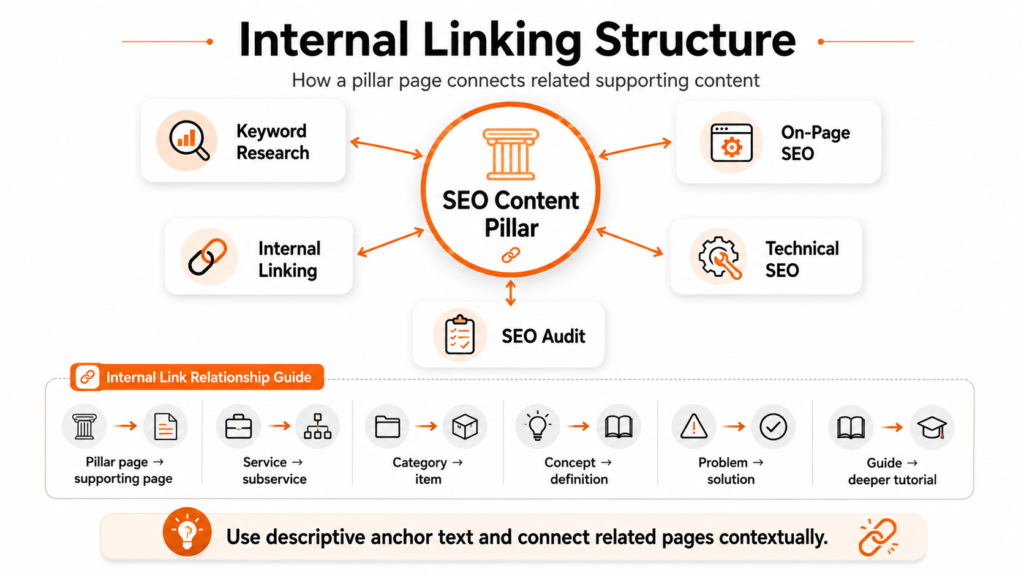
Internal links should connect contextually related pages using descriptive anchor text that tells users and search engines what the destination covers.
A link is the broader entity. Internal links, external links, backlinks, navigational links, and contextual links are narrower types.
For internal SEO architecture, think in relationships:
Pillar page → supporting page
Service → subservice
Category → item
Concept → definition
Problem → solution
Guide → deeper tutorial
Google says links help it discover pages and understand relevance, while descriptive anchor text makes the destination clearer to both users and Google.
So this:
Learn more
communicates little.
This:
SEO keyword research guide
communicates the destination topic before the click.
That does not mean every internal anchor must exactly match a target keyword. Relevance and clarity come first.
How many internal links should a blog post contain?
There is no universal number that makes a page SEO-friendly. Add links when another page materially helps the reader continue the task or understand a related entity.
Ten useful links can make sense in a large guide.
Ten forced links can make a short article harder to read.
The decision should be contextual.
10. Optimize Images, Alt Text, and Search Snippets
Do images help SEO content?
Useful images can strengthen explanation, accessibility, and topical context when they directly support the page rather than decorate it.
Media is the broader category. Images, screenshots, diagrams, charts, infographics, and videos are narrower media types.
Use them for information that is easier to understand visually.
A keyword-research section can show an actual query evaluation.
A technical section can show an indexing report.
A process section can show a workflow diagram.
A comparison can use a chart or table.
That is better than placing a generic laptop photo between two paragraphs because “blogs need images.”
Google recommends relevant images placed near relevant text and advises using descriptive filenames and alt text.
How should alt text be written?
Describe the image’s meaningful content and purpose concisely; do not treat the alt attribute as a second keyword field.
If an image shows a Google Search Console performance report comparing clicks and impressions, describe that information.
Do not write:
“SEO content SEO-friendly content SEO writing Google SEO content optimization.”
That helps neither accessibility nor meaning.
Does a meta description affect rankings?
A meta description is primarily a page summary and snippet input, not a magic ranking field.
Google says it may use the supplied meta description when it provides a more accurate description than text extracted from the page.
Write it for the decision happening in the search result:
What is this page about, and why is it relevant to this query?
A suitable description for this article would be:
Learn how to make SEO-friendly content in 12 practical steps using search intent, semantic structure, original evidence, internal links, on-page SEO, and performance data.
11. Make the Page Crawlable and Indexable
Can strong content rank if Google cannot properly access it?
No. Useful content still needs to be discoverable, crawlable, renderable where required, and eligible for indexing before it can compete in organic search.
The technical sequence is:
Discovery → crawling → rendering → indexing → serving in search.
Google’s documentation describes crawling and indexing as the processes through which Google finds and parses content for possible appearance in Search.
This does not mean every writer needs to become a JavaScript SEO specialist. These accessibility and indexation checks are part of technical SEO, which helps search engines discover, crawl, render, and index important pages correctly.
A page marked noindex cannot solve its ranking problem through better prose. Google explicitly states that a noindex directive prevents an eligible crawled page from appearing in Search.
Likewise, important pages should not depend on inaccessible navigation or remain isolated without useful internal links.
What should be checked before publishing?
Confirm that the intended URL is accessible, returns the expected content, is not unintentionally blocked from indexing, has an appropriate canonical configuration, can be reached through crawlable internal links, and presents the important main content to search engines.
The purpose is not technical perfection.
The purpose is removing technical barriers between a useful document and the systems that need to discover it.
12. Measure the Page, Then Improve the Weakest Stage
How do you know if SEO content is working?
Measure the page across the full search-to-business journey instead of treating ranking position as the final outcome. Effective SEO reporting connects search visibility with clicks, engagement, conversions, leads, and business outcomes.
The useful measurement hierarchy is:
Indexed → impressions → rankings → clicks → engagement → conversions → business outcome.
Each stage diagnoses a different problem.
A page with almost no impressions may have weak demand, poor relevance, indexing problems, or insufficient search visibility.
A page with impressions but few clicks may have weak positioning in the SERP, an unattractive title, an intent mismatch, or simply appear too low to earn significant traffic.
A page with clicks but no meaningful action has a different problem. The traffic may be poorly aligned with the business objective, the content may not support the next decision, or the conversion path may be weak.
That is why “we moved from position eight to position three” is incomplete reporting.
The business question is:
What changed after that ranking improvement?
When should you update SEO content?
Update a page when its facts, evidence, search intent, examples, competitive coverage, links, product information, screenshots, or performance indicate that the current version no longer satisfies the query well.
Do not change the publication date and call that freshness.
A meaningful refresh can replace outdated statistics, correct claims, improve weak answers, add evidence, consolidate overlapping sections, update screenshots, remove broken references, strengthen internal links, or address a new subtopic that has become important.
The cycle is:
Publish → collect data → diagnose → improve → measure again.
That closes the SEO-content process.
SEO-Friendly Content Checklist
Before publishing, evaluate the page as a system rather than checking whether the keyword appears enough times.
| Area | Publish Standard | Failure Signal |
| Audience | A specific reader and problem are defined | Page tries to serve everyone |
| Search intent | Format satisfies the query’s dominant task | Guide targets a buying query or vice versa |
| Keyword | Relevant demand and realistic opportunity exist | Volume is the only selection criterion |
| SERP analysis | Expected coverage and gaps are understood | Competitor headings were simply copied |
| Information gain | Page contributes evidence, examples, experience, or clearer analysis | Content paraphrases existing results |
| Structure | H1–H3 hierarchy follows the topic logically | Headings jump between unrelated contexts |
| Direct answers | Important questions are answered immediately | Answers are buried under introductions |
| Evidence | Important factual claims are verifiable | Numbers and claims lack sources |
| Internal links | Related pages are connected contextually | Important pages are isolated |
| Media | Images or visuals contribute useful information | Decorative stock images dominate |
| Technical access | Page is crawlable and indexable | Blocking or indexing errors exist |
| Measurement | Search and business KPIs are defined | Success is reduced to one ranking number |
If several of those checks fail, publishing faster is usually not the solution.
Fix the information model first.
Can AI-Generated Content Rank on Google?
Google does not prohibit content merely because generative AI was involved; the important issue is whether the finished content is accurate, useful, original, relevant, and compliant with spam policies.
Google says generative AI can help with activities such as topic research and structuring original content. A broader AI SEO strategy focuses on how content is structured, verified, optimized, and surfaced across AI-assisted search experiences. It also warns that using automation to generate many pages without adding value may violate its scaled content abuse policy.
So the wrong question is:
“Did AI write this?”
The more useful questions are:
Who verified it? What original value was added? Are the factual propositions correct? Are the sources valid? Does the page satisfy an actual search need?
AI can accelerate production.
It does not remove editorial responsibility.
How Many Keywords Should You Use in SEO Content?
There is no useful universal keyword count. Cover the primary topic and its necessary entities naturally enough to answer the query without forcing repetition.
A page about SEO-friendly content will naturally mention search intent, keyword research, SERPs, titles, headings, internal links, images, metadata, crawling, indexing, and performance.
Those terms belong because they represent parts, attributes, processes, and outcomes of the parent topic.
That is semantic coverage.
Repeating “SEO-friendly content” 27 times because a content tool recommends a term frequency is not semantic depth.
Google’s Search Essentials recommends using words people use to find your content in prominent locations, but its spam policies prohibit keyword stuffing.
Use language to communicate meaning.
Do not use meaning as an excuse to manufacture language.
How Long Should SEO Content Be?
SEO content should be long enough to satisfy the search task completely and short enough to avoid irrelevant expansion.
A 700-word page can fully resolve a narrow procedural query.
A complex technical guide may require several thousand words.
The relevant variable is information demand, not an arbitrary minimum.
If removing 500 words makes the page clearer without deleting useful information, remove them.
If a missing 300-word section answers an important question competitors ignore, add it.
Harvard’s accessibility guidance emphasizes clarity, semantic structure, and readable presentation rather than unnecessary textual volume.
More words are not automatically more information.
What Is the Biggest SEO Content Mistake?
The biggest strategic mistake is optimizing a document before confirming that it deserves to exist for the target query.
If the query has no meaningful demand, optimization cannot manufacture demand.
If the page targets the wrong intent, additional keywords do not repair the mismatch.
If ten competitors already provide the same information and your page contributes nothing new, another 1,500 words do not create information gain.
If the page cannot be indexed, strong writing cannot make it searchable.
The dependency order is:
Demand → Intent → Useful Answer → Evidence → Search Accessibility → Optimization → Measurement.
Keep that order.
When Should You Use an SEO Tool or Hire an SEO Content Specialist?
Use tools when you need data and repeatable analysis; consider specialist support when the problem requires judgment across search intent, content architecture, technical SEO, evidence, and conversion performance.
A tool can surface query data, crawl URLs, track rankings, identify broken links, or help compare pages.
It cannot automatically decide whether your article contributes something worth publishing.
Professional intervention becomes more useful when content repeatedly receives impressions but fails to improve, multiple pages compete for the same intent, important URLs remain unindexed, content production lacks editorial standards, or organic traffic increases without producing meaningful business outcomes.
That is a different problem from “write more blog posts.”
It requires diagnosis.
Need to Know Why Your Existing Content Is Not Ranking?
If you already publish content but cannot connect it to rankings, qualified traffic, enquiries, or sales, the next useful step is a professional SEO audit.
A proper audit should examine the keyword opportunity, search intent, competing pages, information gaps, semantic structure, internal linking, indexability, search performance, and conversion path before recommending more content.
The objective is not to publish more pages.
It is to identify which pages deserve improvement, consolidation, expansion, or removal—and where new content has a defensible search opportunity.
Final Answer: How Do You Make SEO-Friendly Content?
Start with a real audience and search need. Match the query’s intent, choose a viable keyword, analyze the SERP, contribute original information, structure the answer logically, optimize relevant page elements, connect useful resources, ensure indexability, and measure business outcomes after publishing.
The sequence matters.
Do not start with keyword density.
Do not start with article length.
Do not start by asking an AI tool to rewrite the top five results.
Start with the searcher’s task.
Then create a document that resolves that task more clearly, credibly, and completely than a commodity summary can.
That is what makes SEO content useful to people first—and understandable to search systems second.