RETAIL SEO SERVICES IN DUBAI
Retail SEO Services in Dubai That Drive Store Visits and Online Sales
SEO Company Dubai helps physical stores, ecommerce retailers, and multi-location brands improve product, category, Google Maps, and local search visibility. We connect technical SEO, content, structured data, and conversion tracking to measurable store visits, online sales, and organic revenue.
- Find the technical, product, category, and local-search issues limiting your visibility and sales.
Get Your Free SEO Audit

- 6+ Years of SEO Experience
- 40+ In-House Specialists
- Arabic and English SEO
- 50+ Businesses Supported
Retail Businesses We Support Across Dubai
We support physical stores, ecommerce retailers, multi-location brands and omnichannel businesses with stronger product, category, Google Maps and local search visibility that contributes to store visits, online transactions and measurable revenue.





Your Products Are Available, but Shoppers Find Competitors First
A retail website can look polished and still struggle in search. Google may not understand which products matter most, how your categories relate, which locations carry each item, or which page should rank for a buyer’s query.
You may be dealing with problems like these:
- Your brand ranks, but valuable non-brand product searches bring little traffic.
- Category pages receive impressions without producing enough sales.
- Nearby competitors appear above your stores in Google Maps.
- Filters, variants, and duplicate URLs weaken important product pages.
- Reports show traffic growth but do not connect it to calls, directions, transactions, or revenue.
Retail Search Demand Is Fragmented Across Products, Locations, and Channels
A customer may discover a product through Google, compare it on a category page, check reviews, look for the nearest branch, and then buy online or visit the store. When these parts of the journey are not connected, rankings and conversions suffer.
For example, a fashion retailer may rank for its brand name but remain invisible for searches such as “linen shirts Dubai,” “modest clothing store near me,” or “women’s boutique Dubai Marina.” An electronics retailer may have thousands of indexed products while its highest-value category pages remain difficult to find.
Dubai Retail Demand Changes Throughout the Year
Search behaviour can shift around Ramadan, Eid, Dubai Shopping Festival, product launches, tourism periods, and seasonal promotions. Different audiences may also search in English, Arabic, or mixed-language terms.
Publishing campaign pages after demand has already increased leaves little time for crawling, indexing, internal linking, and performance testing. Your retail SEO plan needs to prepare important categories, products, and locations before shoppers begin searching.
Traffic Alone Does Not Prove Retail Growth
Higher visits can look positive in a report, but they do not show whether people found profitable products, requested directions, contacted a store, added items to a cart, or completed a purchase.
A useful retail SEO strategy connects each search activity with a business outcome:
Product discovery → category visit → store or checkout action → measured sale
The next section explains how SEO Company Dubai connects product visibility, local discovery, technical performance, and conversion measurement within one retail SEO system.
This approach helps Dubai retail stores increase qualified traffic, improve user experience, and grow revenue across online and offline channels.
A Complete Retail SEO System, Not a Generic Keyword Package
Retail SEO works best when product visibility, store discovery, technical performance, content, and measurement support the same customer journey. Your campaign is built around how shoppers search, compare, locate, and buy from your business.
1. Retail Search Demand and Entity Mapping
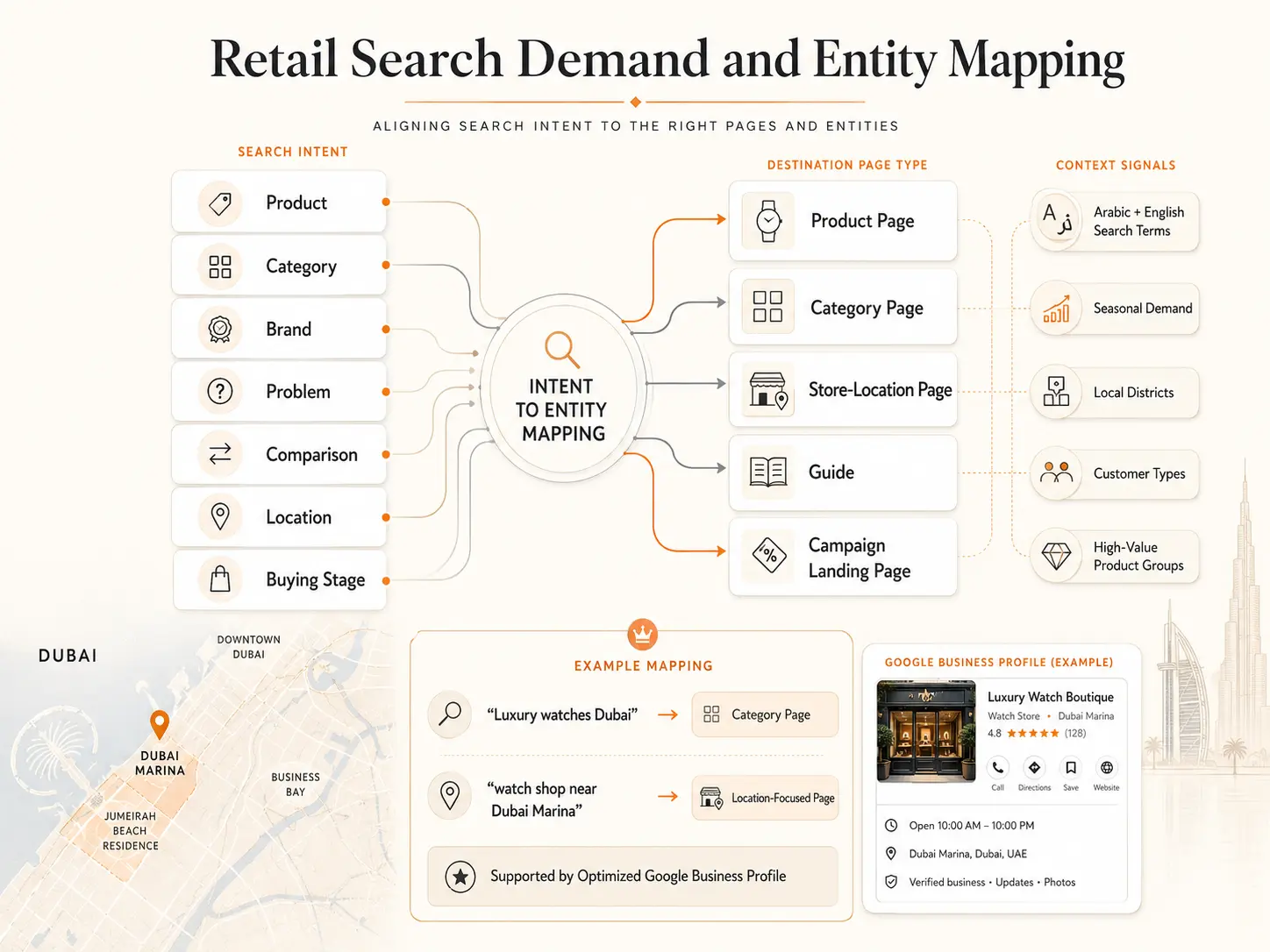
We map searches by product, category, brand, problem, comparison, location, and buying stage. This shows which queries need a product page, category page, store-location page, guide, or campaign landing page.
The research can also account for Arabic and English search terms, seasonal demand, local districts, customer types, and high-value product groups.
Example:
“Luxury watches Dubai” may require a category page, while “watch shop near Dubai Marina” needs a location-focused page supported by an optimized Google Business Profile.
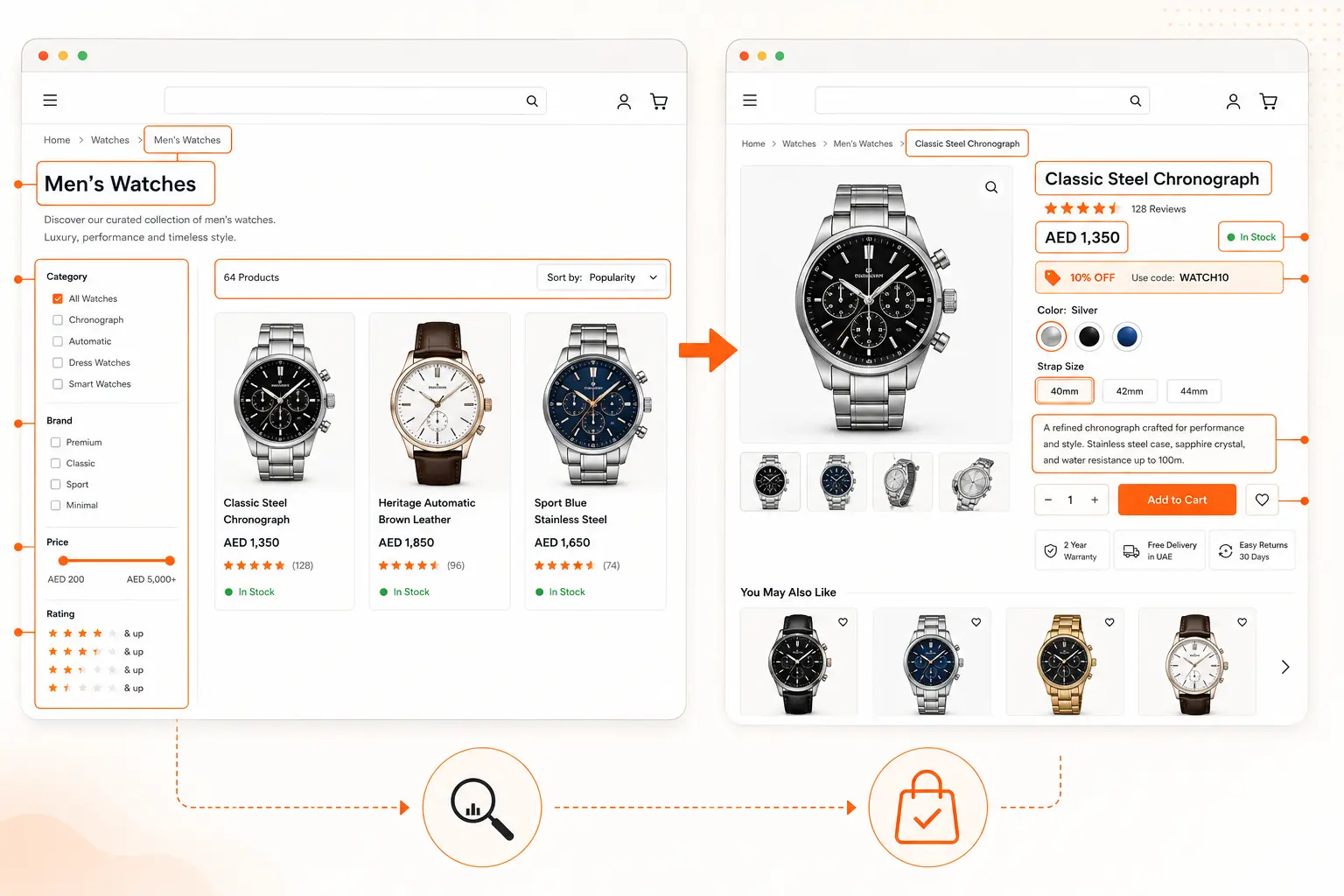
Your priority product, category, brand, and collection pages are improved for relevance, clarity, and conversion intent. This can include titles, meta descriptions, headings, product copy, category introductions, images, internal links, breadcrumbs, and structured data.
The goal is to help search engines understand what each page represents while giving shoppers the details they need to compare products and make a decision.
Where suitable, structured data may describe:
- Product names and variants
- Prices and availability
- Offers and reviews
- Brand relationships
- Category hierarchy
- Store or business information
Large retail catalogs often create technical problems that smaller websites do not face. We review the systems that affect how product and category pages are crawled, indexed, rendered, and prioritized.
This may include:
- Faceted navigation and product filters
- Canonical URLs and pagination
- Product variants
- Duplicate content
- JavaScript rendering
- Internal search pages
- Out-of-stock and discontinued products
- Mobile performance
- Crawl depth and orphaned pages
- Product-feed and website-data consistency
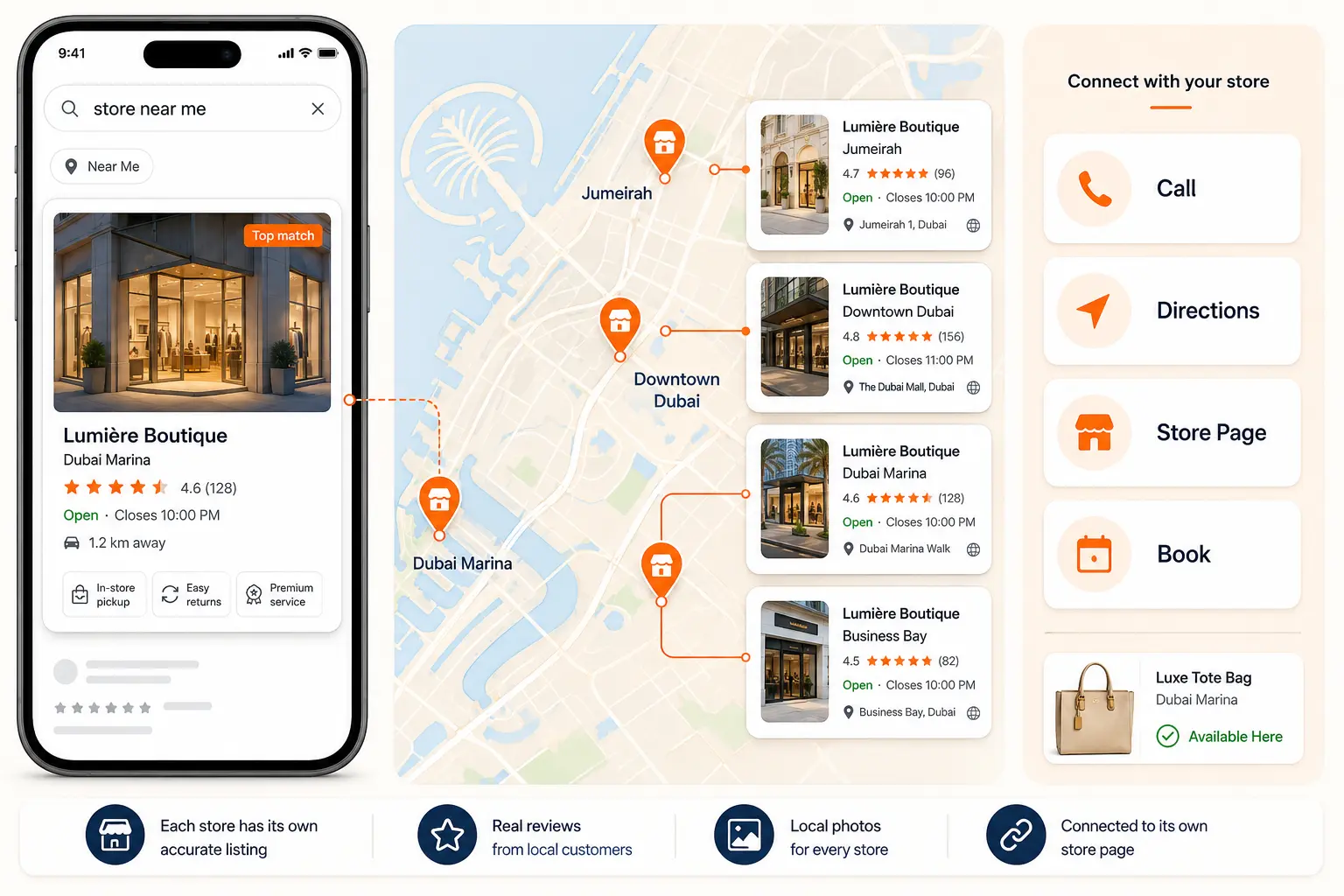
For physical stores, search visibility depends on more than the main website. Each eligible location needs consistent business information, a useful store page, an optimized Google Business Profile, relevant reviews, local citations, photographs, and clear links between the website and the physical branch.
The strategy can target actions such as:
- Calls
- Direction requests
- Store-page visits
- Appointment bookings
- “Near me” searches
- Product-plus-location searches
- Branch discovery across Dubai districts
Multi-location retailers receive a structured approach for each real branch rather than duplicate pages with only the area name changed.
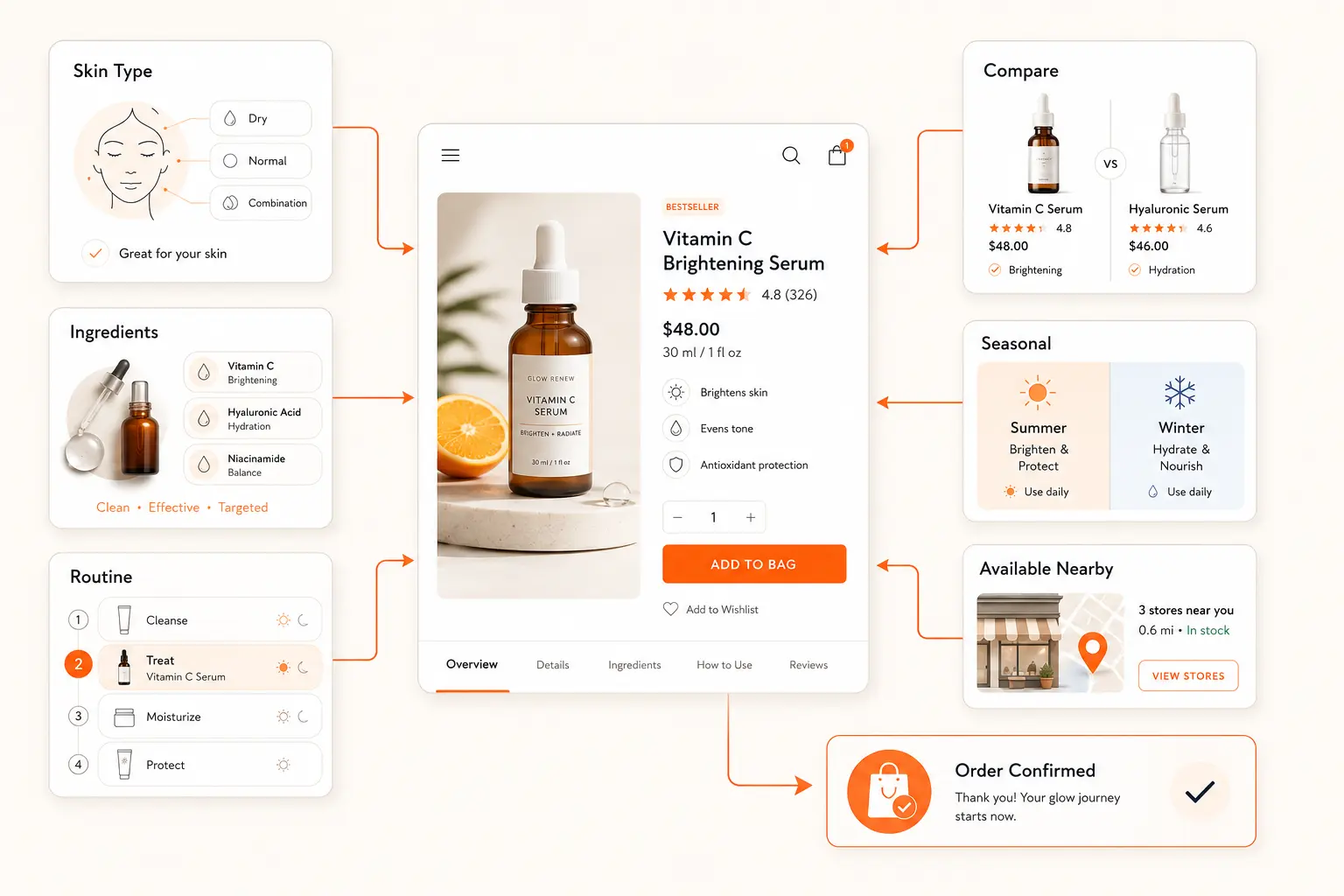
Retail content must support buying decisions, not simply increase the number of indexed pages. Your content plan may include category guides, buying comparisons, product-use resources, seasonal pages, brand content, location information, and campaign landing pages.
These assets help connect your business with the products, problems, audiences, locations, and purchase situations that matter to your customers.
For example, a beauty retailer may need more than individual product pages. It may also need content around skin type, product ingredients, routines, comparisons, seasonal concerns, and store availability.
6. Measurement and Revenue Attribution
Your reports should show more than rankings and traffic. We define the actions that represent value for your retail business and connect them to the relevant landing pages, products, locations, and search queries.
Depending on your setup, measurement can include:
- Non-brand product clicks
- Category-page visibility
- Product views
- Add-to-cart actions
- Organic transactions
- Organic revenue
- Calls and form submissions
- Direction requests
- Store-location page actions
- Assisted conversions
This helps you see which SEO activities support sales and which areas need further work.
You receive one connected retail SEO system designed to help customers discover your products, find the right store, complete a purchase, and create measurable business value.
Real Results for a Dubai Retail Store
We helped this retail store improve product and local search visibility, drive more qualified traffic, and increase online orders and in-store visits.
Dubai Retail Store SEO Case Study
A premium retail store with multiple product categories and physical locations across Dubai. We implemented a data-driven SEO strategy focused on product visibility, category pages, technical SEO, and local optimization.
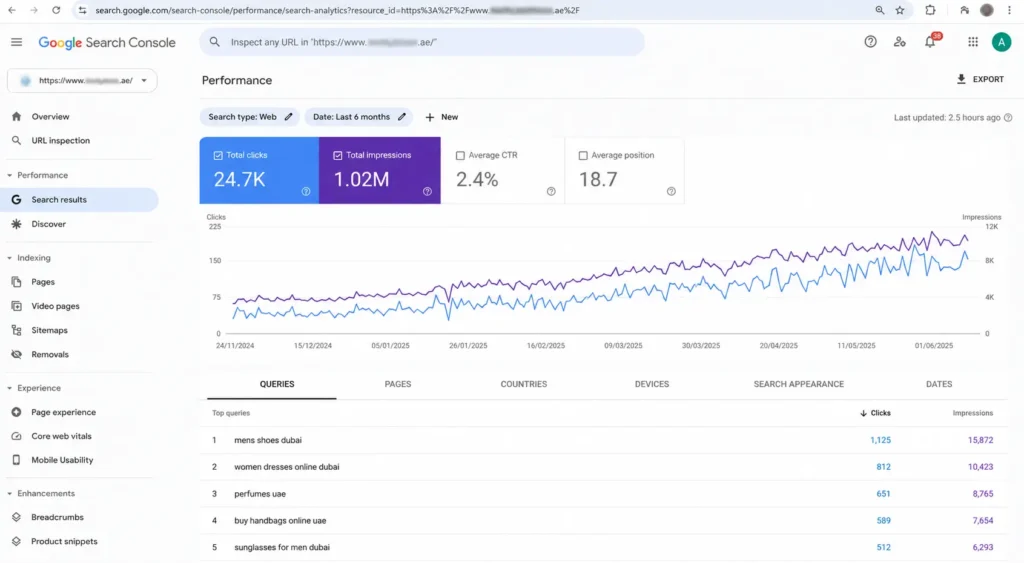
Results vary based on competition, industry, and the current state of your website.
See Retail SEO Pricing in Dubai
Review clear SEO pricing options designed for physical stores, ecommerce retailers, and multi-location brands in Dubai seeking stronger product visibility, local discovery, online sales, and measurable organic growth.
A Clear Retail SEO Process From Audit to Growth
You should know what is being reviewed, what will change, and how each task supports your retail goals. Our process turns a complex website, catalog, and store network into a prioritized plan your team can follow.
Step 1 — Establish Your Current Search Baseline
We review your website, product catalog, category structure, store locations, Google Business Profiles, competitors, and tracking setup. Existing visibility is separated into branded, non-branded, product, category, and local searches.
You receive a clear view of what is already working and where qualified demand is being lost.
Step 2 — Map Products, Locations, and Search Intent
We connect search terms with the correct product, category, brand, campaign, guide, or store-location page. This prevents several pages from competing for the same query and reveals where important landing pages are missing.
The plan can also account for Arabic and English searches, seasonal demand, product margins, stock priorities, and store locations.
Step 3 — Fix Technical and Indexation Barriers
We prioritize issues that prevent search engines from crawling, understanding, or ranking your most valuable pages. These may include duplicate URLs, uncontrolled filters, weak canonicals, rendering problems, slow templates, broken internal links, or inconsistent structured data.
Each recommendation is assigned to SEO Company Dubai, your internal team, or your development provider. You know who is responsible before implementation begins.
Step 4 — Improve Commercial and Local Pages
Priority category, product, brand, and store pages are improved according to search intent and commercial value. This can include copy, metadata, internal links, product data, local details, schema, images, reviews, and conversion paths.
The work begins with the pages closest to sales rather than publishing large amounts of low-priority content.
Step 5 — Measure, Refine, and Expand
We review query data, landing-page performance, ecommerce actions, calls, direction requests, transactions, and revenue where tracking allows. The next sprint is based on evidence from your products, categories, and locations.
This creates a controlled growth cycle instead of a fixed checklist repeated every month.
No unexplained task lists. No blind content production. No promises that an agency cannot control.
See which technical, product, content, and local-search priorities belong in your first campaign.
Retail SEO Built Around Products, Stores, and Revenue
A retailer needs more than a general SEO checklist. Your strategy must account for product discovery, category competition, physical locations, catalog changes, customer journeys, and the actions that create commercial value.
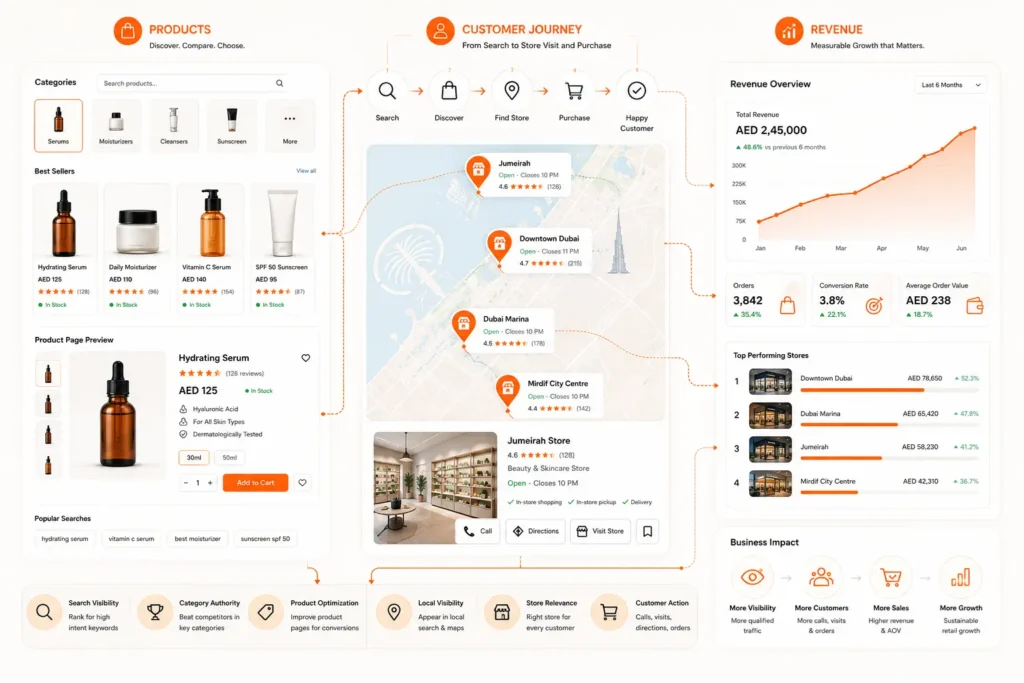
One Strategy for Online and Physical Retail
Your ecommerce and local-search campaigns work as one system. Product pages, category pages, store pages, Google Maps visibility, click-and-collect journeys, and online transactions support the same customer experience.
This helps you avoid separate campaigns that compete for budget but do not share data or priorities.
Commercial Pages Come Before Publishing Volume
We prioritize pages based on demand, business value, ranking potential, and their role in the purchase journey. A high-value category page may deserve attention before twenty new blog posts.
You receive work linked to a clear commercial reason, not a monthly word-count target.
Technical Planning for Large Retail Catalogs
Filters, variants, stock changes, pagination, product feeds, and JavaScript can create thousands of crawlable URLs. We evaluate these systems as part of your retail architecture rather than treating every URL as an isolated page.
This protects important products and categories from duplicate content, crawl waste, and weak internal signals.
Dubai-Specific Search Planning
Your strategy can reflect how residents, tourists, and business buyers search across Dubai districts and retail periods. This may include local store discovery, shopping destinations, seasonal campaigns, mobile searches, and Arabic-English query differences.
Location names are used only where the business has a genuine connection and useful information for the shopper.
Clear Implementation Ownership
A recommendation has little value when nobody knows who must complete it. Every important action is assigned to our team, your developer, your ecommerce manager, or another responsible party.
Dependencies, priority, and validation steps are documented so work does not disappear inside an audit report.
Reporting Connected to Retail Outcomes
Rankings can indicate visibility, but they do not prove commercial success. Your reporting can connect organic search with category visits, product views, calls, directions, carts, transactions, revenue, and assisted conversions.
This helps you judge the campaign by business evidence instead of isolated keyword movement.
Know What Your Retail SEO Engagement Covers
Your proposal defines the number of products, categories, locations, languages, content assets, and implementation hours included. Work outside that scope is discussed before it is added.
Included in the agreed scope
- Retail search-demand and competitor analysis
- Product, category, brand, and location-page planning
- Technical ecommerce SEO audit
- Priority product and category optimization
- Faceted-navigation and indexation recommendations
- Internal-link and site-architecture planning
- Relevant product and business structured data
- Google Business Profile and store-page optimization
- Content briefs and retail authority planning
- Analytics and conversion-measurement planning
- Monthly priorities and performance reporting
Not included unless separately agreed
- Guaranteed rankings or fixed revenue outcomes
- Fake reviews or fabricated business locations
- PPC advertising spend or campaign management
- Daily catalog administration or product entry
- Full website redesign or custom software development
- Unlimited content outside the approved roadmap
- Marketplace SEO for Amazon, Noon, or other platforms
- Influencer, social-media, or email marketing management
- Translation without separate search-intent research
- Work requiring access that has not been provided
- Immediate results before crawling and implementation occur
Scope Note
The exact deliverables depend on your retail model. A single physical store, a multi-location chain, and a large ecommerce catalog do not require the same level of technical work, content, or measurement.
Get a plan based on your platform, product catalog, locations, languages, and growth priorities.
Common Mistakes That Reduce Retail Search Visibility
These problems often build slowly. A website may remain live and continue receiving traffic while its strongest categories, products, or locations lose search value.
Allowing Every Product Filter to Be Indexed
Colour, size, price, brand, and sorting filters can create thousands of URL combinations. When every variation is crawlable, search engines may spend more time on weak pages than on your main categories.
Better approach:
Decide which facets have real search demand and control the rest through crawl, indexation, canonical, and internal-link rules.
Making Product Pages Compete With Category Pages
A broad category and several similar products may target the same phrase. This creates internal competition and makes it difficult for search engines to identify the best page.
Better approach:
Assign broad commercial demand to categories and specific model, variant, or attribute searches to product pages.
Copying Manufacturer Product Descriptions
Duplicate supplier copy gives shoppers little reason to choose your result over another retailer selling the same item.
Better approach:
Add useful details such as sizing, compatibility, use cases, delivery information, local availability, comparisons, and buying guidance.
Deleting Out-of-Stock Products Without a Rule
Removing an unavailable product can waste historical rankings, links, and useful customer information. Keeping every discontinued page can also create a poor experience.
Better approach:
Use a defined system for temporary stock loss, permanent discontinuation, replacements, redirects, and page removal.
Creating Near-Duplicate Store Pages
Changing only the district name does not create meaningful local relevance. These pages offer little help to customers and may resemble doorway pages.
Better approach:
Give each real location accurate store details, opening information, directions, photographs, nearby landmarks, services, and relevant inventory context.
Translating English Keywords Directly Into Arabic
Shoppers may use different terms, transliterations, modifiers, and product names in each language. Literal translation can miss actual demand.
Better approach:
Research Arabic and English separately, then connect them through a clear multilingual architecture and correct hreflang implementation.
Launching Seasonal Pages Too Late
A Ramadan, Eid, Dubai Shopping Festival, or sale page needs time to be crawled, indexed, linked, and tested.
Better approach:
Prepare important pages, product feeds, internal links, and campaign content before search demand begins to rise.
Measuring Traffic Without Sales Actions
More visits do not show whether shoppers found suitable products, contacted a branch, requested directions, or completed a transaction.
Better approach:
Track search performance alongside product views, carts, calls, location actions, purchases, revenue, and assisted conversions.
Tell us which catalog, store-page, technical, or tracking issues are limiting your retail growth.
What Your First 90 Days Can Look Like
The first 90 days establish priorities, correct major barriers, and create a reliable base for growth. This roadmap does not guarantee a fixed ranking or revenue increase within three months.
Days 1–30 — Diagnose and Prioritize
Primary objective: Understand the website, demand, and measurement gaps before making large changes.
Typical work includes:
- Analytics and conversion-tracking validation
- Search Console and indexation review
- Product, category, brand, and location-page inventory
- Retail keyword and entity research
- Competitor and content-gap analysis
- Faceted-navigation assessment
- Structured-data validation
- Google Business Profile review
- Internal-link and crawl-depth analysis
- Implementation ownership planning
You receive:
A baseline report and prioritized backlog showing what needs attention, why it matters, and who will handle it.
Days 31–60 — Repair and Strengthen
Primary objective: Improve the pages and systems closest to discovery and revenue.
Typical work includes:
- High-priority technical corrections
- Category and product-page optimization
- Canonical and indexation improvements
- Internal-link restructuring
- Structured-data corrections
- Store-location page upgrades
- Google Business Profile improvements
- Content briefs for missing commercial pages
- Arabic and English architecture where included
- Seasonal landing-page preparation
You receive:
A stronger search foundation with clearer product relationships, better crawl paths, and more useful local signals.
Days 61–90 — Expand and Measure
Primary objective: Build supporting authority and use early evidence to guide the next stage.
Typical work includes:
- New category, guide, brand, or location content
- Additional product-page improvements
- Shopping-feed consistency checks
- Relevant authority and digital PR activity
- Query and landing-page performance analysis
- Ecommerce and local-conversion review
- Underperforming-page adjustments
- Next-quarter expansion planning
You receive:
A measured growth plan for the categories, locations, and content clusters showing the strongest opportunity.
You will know what changed, why it was prioritized, who completed it, and which metric will be used to evaluate it.
Retail SEO Questions, Answered Clearly
The timeline depends on your starting position, competition, implementation speed, website quality, and available resources.
SEO Company Dubai provides transparent work, measurement, and prioritization rather than a guarantee no agency can control.
We do not create large numbers of near-duplicate location pages.
Still unsure whether your catalog, store locations, or tracking setup is ready?
Tell us what you sell, where you operate, and what is limiting growth.